Anthropic and Figma's new MCPs could transform front end development forever

Plus: Perplexity's new Email Assistant, Become a systems thinker, 3 new Gemini updates worth knowing about...
This week’s briefing is supported by Enterpret - the new way to tie all of your customer feedback back to critical metrics like revenue, NPS and CSAT thanks to its sophisticated knowledge graph.
Perplexity’s Head of CX used Enterpret’s new AI monitoring to discover a major billing issue that would have taken hours to diagnose. Enterpret was “spot on, no noise - just actionable insights”.
Hi product people 👋,
Coming up this week, Claude Code and Figma show us their new MCP connectors which could transform front end development as we know it, Google Gemini unveils 3 new major updates and a new study warns about the rise of “workslop” and why you should think twice before sending a AI-generated artifacts to colleagues.
Happy Friday and have a great weekend!
Watch on YouTube | Follow on Substack Notes
Key reads and resources for product teams
Deep dive - What new AI features are product teams building?
It’s been almost 4 months since the last Deep dive on new AI features. In this edition, learn more about YouTube’s AI-powered lip-sync dubbing, Audible’s generative AI for audiobooks, Uber Eats’ AI-enhanced restaurant listings, Reddit’s AI-driven ad products, Pinterest’s auto-collages, and Notion’s multi-step AI agents. This DoP Deep dive contains 30+ examples from over 25 different tech companies including Linear, Reddit, Amazon, YouTube, Google Maps, Gusto, Miro, Intercom, Proton and more. (Department of Product)
AI prompts and mini apps Library
New AI prompts added to the library this week:
Build your own meditation / breathing app to help you stay focused
Become a systems thinker to tackle your goals and boost productivity
Use the 80/20 principle for product roadmap prioritization
Resource - MCP Directory from GitHub
GitHub has launched a new comprehensive MCP Directory which lists all of the official MCP servers you can use in your own product or AI app. Each server is backed by its GitHub repository, so you can learn what it does, how to get started, and make informed choices quickly. (GitHub)
UX - A designer’s guide to AI prototyping
Many AI tools have a chat mode or planning phase; use them to refine your idea and clarify how your design should be implemented. Design Engineering Manager CJ Gammon explains more. (Adobe Design)
Product strategy - Is the Innovator’s Dilemma Outdated?
If more and more software starts to look like a smart robot and a spreadsheet, the platform and the product are effectively the same thing. In an AI marketer—or an AI analyst, or an AI engineer—where’s the line between the application and the foundational infrastructure? How will your startup survive if Anthropic accidentally builds the same thing you’re building? (Benn Substack)
Leadership - How to move beyond either-or decision making as a leader
Jennifer Riel, an adjunct professor at the Rotman School of Management, presents a model way to solve problems: integrative thinking. It enables leaders to move beyond either-or decisions to make stronger choices. (Harvard Business Review)
New product features and innovation this week

Claude has added support for a new MCP Connector with a Figma integration that could be helpful for designers and developers. The MCP can view Figma mock ups at the data level (things like components, design tokens and layout rules) and translate this into production-ready code. Early feedback is mixed with some designers saying that the MCP connection only works if Figma is configured perfectly and others saying that this could mark the end of front end development as we know it. Here’s an example of it building a pricing page from a Figma design file and the result is actually pretty impressive.
Figma has also confirmed that it now supports MCP on Figma Make - its Lovable competitor. This makes it easier for non-designers to mock up prototypes in Make that match design systems set up in Figma.
The new releases are yet another step towards a future in which the lines between engineering, design and product management are blurred.
In other news…
Perplexity has launched a new Email Assistant which could come in handy for product teams. You can add the Perplexity Email Assistant to any email thread and it will check availability, suggest meeting times and send calendar invites. It will also read your inbox and automatically label and organize your emails - and even auto-draft responses that match your existing tone and style. But, here’s the catch: the new Assistant is only available for Max users who pay $200 a month. 10x the price of alternatives like Superhuman. If the most useful features of products like Perplexity are gate-kept behind sky high $200 paywalls (presumably because they are expensive to run), then what exactly does this say about the unit economics and future viability of AI companies like Perplexity?
3 new Gemini updates
Elsewhere this week, Google gave us 3 significant new Gemini updates that are worth knowing about.
Google is starting the rollout of Gemini in Chrome to all Workspace users. Gemini in Chrome is Google’s version of an AI-browser that can perform most of the tasks of other AI browsers like Dia and Comet such as summarizing web pages and referencing content across multiple tabs. To coincide with the rollout, Chrome is getting a development MCP server which could be helpful for product and engineering teams to debug issues in tools like Cursor and Claude Code. Here’s a demo of that in action where it automatically performs an audit of a website and generates a report on any performance issues.
Google also revealed an updated version of its Gemini Live Voice APIs. According to the product managers who worked on the release, the new version is twice as good at successfully calling the right functions and also has new features which make it sound more natural and fluid such as pausing in the right place and an improvement in ‘barge-in’ recognition (where a user interrupts the AI voice assistant). The new models could be super helpful for product teams who are considering building AI-powered voice customer support channels.
And thirdly, Google Live Search is finally starting to get released across the US. This new way to search lets you select the “live button” and then start a conversation with your camera switched on to get answers to questions.
Microsoft unleashes new agentic tools to tackle tech debt
At its Migrate and Modernize conference, Microsoft has revealed new agentic tools designed to help engineers and product teams tackle tech debt. The new tools include new capabilities in GitHub Copilot which analyze your codebase, suggest safe migration paths and build those changes. Microsoft says the new tools are already significantly reducing the amount of time it would previously take to address tech debt issues and migrate to new versions of programming languages.
Tools you can use
Enterpret - Turn user feedback chaos into actionable customer intelligence. Product teams at companies like Canva, Notion and Perplexity use Enterpret to manage spikes, stack-rank work, and track sentiment after launches.*
Ambient - your AI Chief of Staff that preps you for every meeting, keeps your team accountable & aligned, and helps you stay on top of key initiatives.
Tooljet - AI agents that will build full stack internal apps for you.
Architech - visualise your codebase and system architecture. Ideal for whiteboarding sessions with engineers when you want to get to grips with technical concepts quickly.
📈 Product data and trends to stay informed
While employees might say AI makes them more productive, a new Harvard Business Review study shows that 40% of respondents had encountered what they call “workslop”. Workslop is content or other artifacts that “appears polished but lack real substance”. Researchers estimate workslop incidents costs $186 per month and 37% of workers who receive workslop view the colleague who sent it as less intelligent.
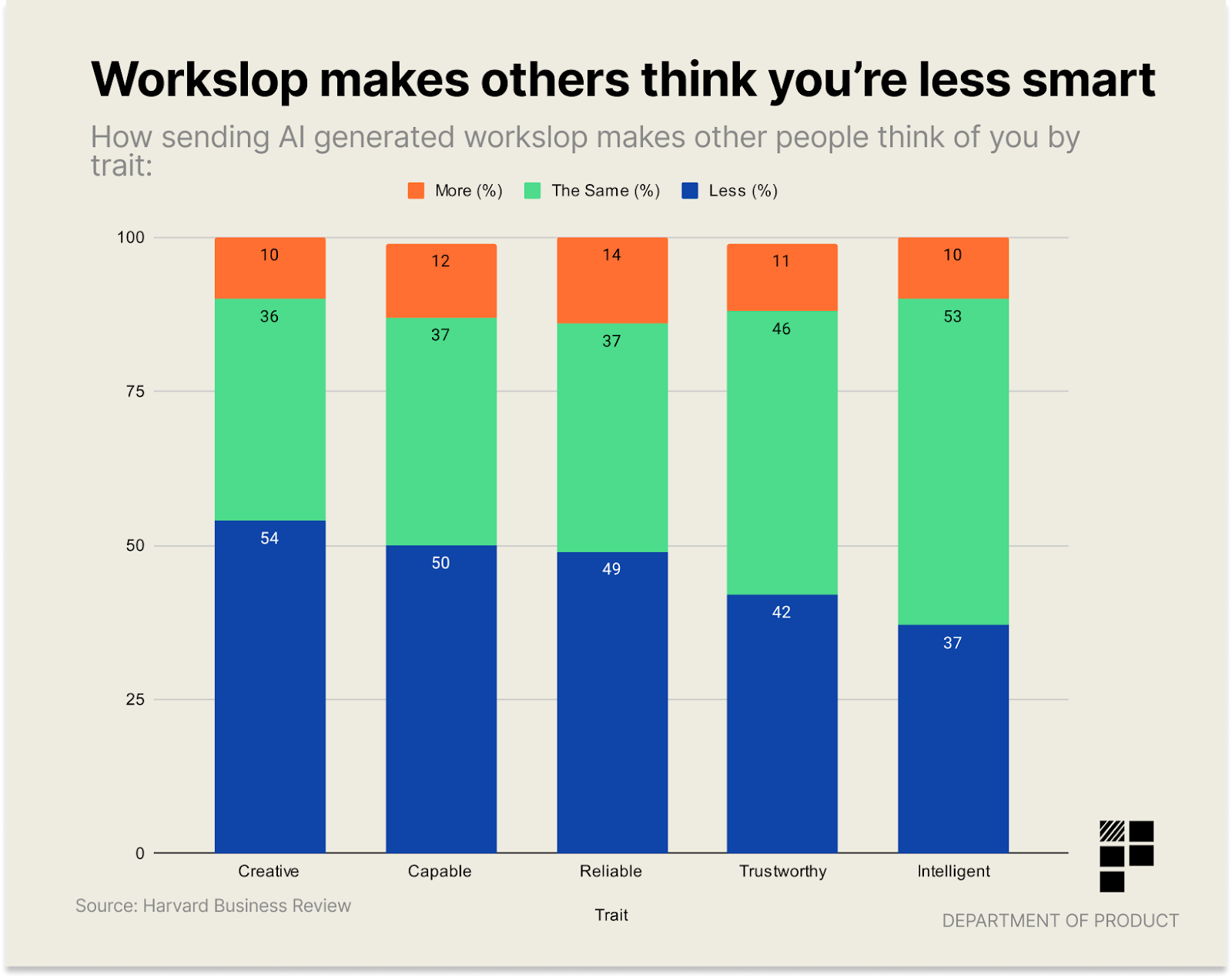
Google released its annual DORA report on the state of AI-assisted Software Development. 90% of software development professionals are now using AI at work with 80% of respondents saying that AI adoption has increased their productivity. Engineers are increasingly finding AI generated code valuable but not necessarily trustworthy. 24% have “a great deal” (4%) or “a lot” (20%) of trust in AI, but 30% trust it “a little”or “not at all”.
Other stats from the report worth knowing for product teams:
Only 16% of companies are deploying to production multiple times a day
A median of 2 hours a day is spent using AI tools at work
~ 1% of people never use AI to solve a problem
Writing new code is the most common use case for engineers who use AI at 60%
Market differentiation is the most common benefit of introducing AI into large companies according to analysis by the FT. The most common concern? Security. Full analysis here.
Google Search traffic to news websites has plummeted 89% for the Daily Mail and 25-30% to the Financial Times. What impact could this have on SaaS? App monetization SaaS product RevenueCat says that 35% of all new sign ups now come from AI search products.
5000 Citigroup staff are set to get access to AI agents as part of a trial that will last 4-6 weeks. The tasks will typically take a few minutes, but the vision is to eventually assign tasks to agents that could take hours. “Does it mean that we need less people? I don’t know,” he said. “It certainly means that we would get a lot more done. And we’ll see how the workforce evolves with that massive boost of capacity that we’re getting here.”
Amazon’s AI engineering product Q is lagging behind rivals with projected annual revenues of just $16.3 million. Leaked Slack messages show that Amazon’s own employees are turning to tools like Cursor instead.

Paid subscribers get the full DoP Substack including: The Knowledge Series for sharpening your tech skills, AI tutorials for putting AI into practice at work and DoP Deep dive reports to learn from the world’s top tech companies.