Microsoft, Anthropic and Cursor accelerate the AI Agent takeover

Plus: OpenAI’s consumer product strategy, SEO is dying, How to win in GEO, Nano Banana comes to Slides...
Hi product people 👋,
A warm welcome to the 3,000+ subscribers who have joined the DoP Substack and YouTube this past month - I’m incredibly grateful for your support and I hope you enjoy your time here!
Coming up in this week’s product briefing, I take a look at OpenAI’s consumer product strategy and whether it can build its own Meta-style “family of apps”. Plus, the rise of AI agents continues with new agentic features for Excel, Replit and Anthropic and Google’s Jaclyn Konzelman outlines the characteristics and skills she looks for when hiring new AI product managers at Google.
Happy Friday and have a great weekend!
Rich
Watch on YouTube | Follow on Substack Notes
Microsoft’s AI agents “can speak Excel” natively
First up this week, Microsoft has launched a major new set of AI agents that it is labelling “vibe working”. The “vibe”-oriented branding is a little cringe at this point but if these agents can do what Microsoft claims then they’ll be a pretty disruptive addition to the workplace productivity stack. The agents include Agent Mode in Excel, Word and Powerpoint and Microsoft says that its spreadsheet agent “can speak Excel” natively, meaning it can create spreadsheets and evaluate them. The capabilities are assessed against an OpenAI benchmark called SpreadsheetBench and Excel scores 57.2% vs 71.3% for human spreadsheet editors.
Microsoft’s product leaders published a blog post outlining the technologies used in building these new agents which is also an interesting read that you can read here.
There is seemingly no stopping the march of AI agents right now and Claude’s latest models do nothing to dampen the hype. Released earlier this week, Claude 4.5 outperforms all other models in agentic tasks and its agents can run continuously for up to 30 hours which is reasonably terrifying. More on that in the latest Chartpack.
And Cursor unveiled its new agentic abilities, too. These new capabilities give Cursor control of your browser which allows it to do things like take screenshots to debug issues, improve UI and more.
OpenAI places its consumer product bets and partners with Stripe to develop a new payment standard
OpenAI ramped up its consumer product strategy with the launch of a new Sora video app and new shopping capabilities in ChatGPT.
The Sora app is OpenAI’s first major move into the consumer product space (outside of ChatGPT). So far, the app’s most popular type of video seems to be memes involving CEO Sam Altman and the market response has been mixed. One commentator mocked the company for shifting its strategy away from lofty goals like curing cancer to AI video slop, but Altman defended Sora by saying that “reality is nuanced when it comes to optimal trajectories for a company.
On the face of it, this shift into consumer products makes sense; if OpenAI can successfully steal the Meta playbook of cross-selling its users across different apps and build a “family” of products, then it may just work. It owns the models and once they reach a certain level, the strategy is to build world-class apps on top of it. With ChatGPT now pushing 1 billion users, they certainly have plenty of legroom to trial different cross-sell tactics, but scale doesn’t guarantee stickiness.
Putting the app itself if you take a closer look at their promotional materials, one aspect of their new release could be particularly relevant for product teams; Sora lets users “Continue with ChatGPT” - a new type of login that could pave the way for it to compete with the likes of Google for single sign on. This could drive network effects further.
Stripe’s new protocol for agentic payments
OpenAI’s new shopping feature allows users to buy products directly inside ChatGPT and has been built in partnership with Stripe. As part of this, Stripe announced a new open standard payments protocol called ACP (Agentic Commerce Protocol) which provides a blueprint for how businesses can make their checkouts agent-ready so that customers using AI agents, such as ChatGPT, can buy products directly from where they’re discovering them. Stripe published a post summarizing how this new protocol works which is worth a read if you’re keen to get up to speed quickly with how payment methods and ecommerce might evolve to adapt to AI agents.
Shopify and Etsy and early backers of the new agentic payments model but there of course, fears of what disintermediation might do to a product’s relationship with its users.
In other news…
If you’re a Google Slides user, this new feature should come in handy: you can now use Nano Banana natively inside Slides to make edits to images. As well as editing, you can use prompts inside Slides to place objects in different surroundings e.g. “Place this product in a New York Subway station.”
Nothing, the smartphone manufacturer, has launched a new feature that will let users vibe code their own mini apps with simple text prompts and then publish them in their App Store. They look a bit like widgets and Nothing says they won’t be full screen apps for now since the technology isn’t quite ready. Some of the mini apps that people have already built so far include a flight tracker, next meeting brief and virtual pet. Nothing is, of course, a niche product, but it’ll be interesting to see if Apple or Google follow suit - and what this might mean for mobile app product teams.
Replit released some vibe coding updates of its own with “Connectors” - mini automations that allow you to build mini apps through automations that connect Replit’s Agent to third party software like Notion, Discord and Zendesk.
Key reads and resources for product teams
New from the Department of Product Substack this week:
Knowledge Series - Practical ways to use MCP at work
Explore some of the practical, real world ways you can use MCP at work including: automatically conduct market research and competitor analysis in your browser, create prototypes and deploy them to production with Figma and Claude, get status updates from Linear in Perplexity, build your own personal Chief of Staff who provides you with a daily briefing and more.
New prompts in the AI Prompt Library
This week, there are a bunch of new AI prompts in the prompt library you can use including:
This prompt can be used to build a personalized, interactive course app to teach yourself about any topic - with different learning formats, quizzes and further reading
A prompt that uses scientific frameworks to help you address root causes of procrastination at work and come up with strategies to help you stay focused
Careers - What I look for in an AI product manager at Google
In this 3 parter, Google’s Jaclyn Konzelman outlines the characteristics and skills she looks for when hiring new AI product managers at Google, as well as the 5 questions she asks every AI PM candidate. (Thursday Thoughts)
Resource - Amplitude product benchmarks report
Get the latest data on benchmarks like activation, retention, engagement and more. The 2025 edition draws on anonymized data from over 2,300 organizations, enabling product teams to compare their own performance with industry standards and top-performing products. (Amplitude)
Strategy - SEO is tanking. How to win with GEO / AEO instead
Answer Engine Optimization reframes SEO for AI agents that read and synthesize content into answers, making clarity, structure, and citations more important than design (Carilu Dietrich Substack)
Podcast - The birth of the Excel spreadsheet
Excel turned 40 this week and this podcast explains the product origin story behind it:
Tools you can use
Alex - automate your entire recruiting process with an AI recruiter. This week raised $17 million.
Integrity - bring your notes, canvases and AI chats all into one single workspace. It looks a bit like a combination of Claude, Notion and Miro.
Pencil - design mode for Cursor. Backed by A16z, it embeds visual design directly inside IDEs like Cursor. Looks pretty impressive.
📈 Product data and trends to stay informed
In the latest DoP poll, I’m asking you what product team role you think is most likely to be replaced by AI - so far product management is winning but what do you think? Add your opinion here.
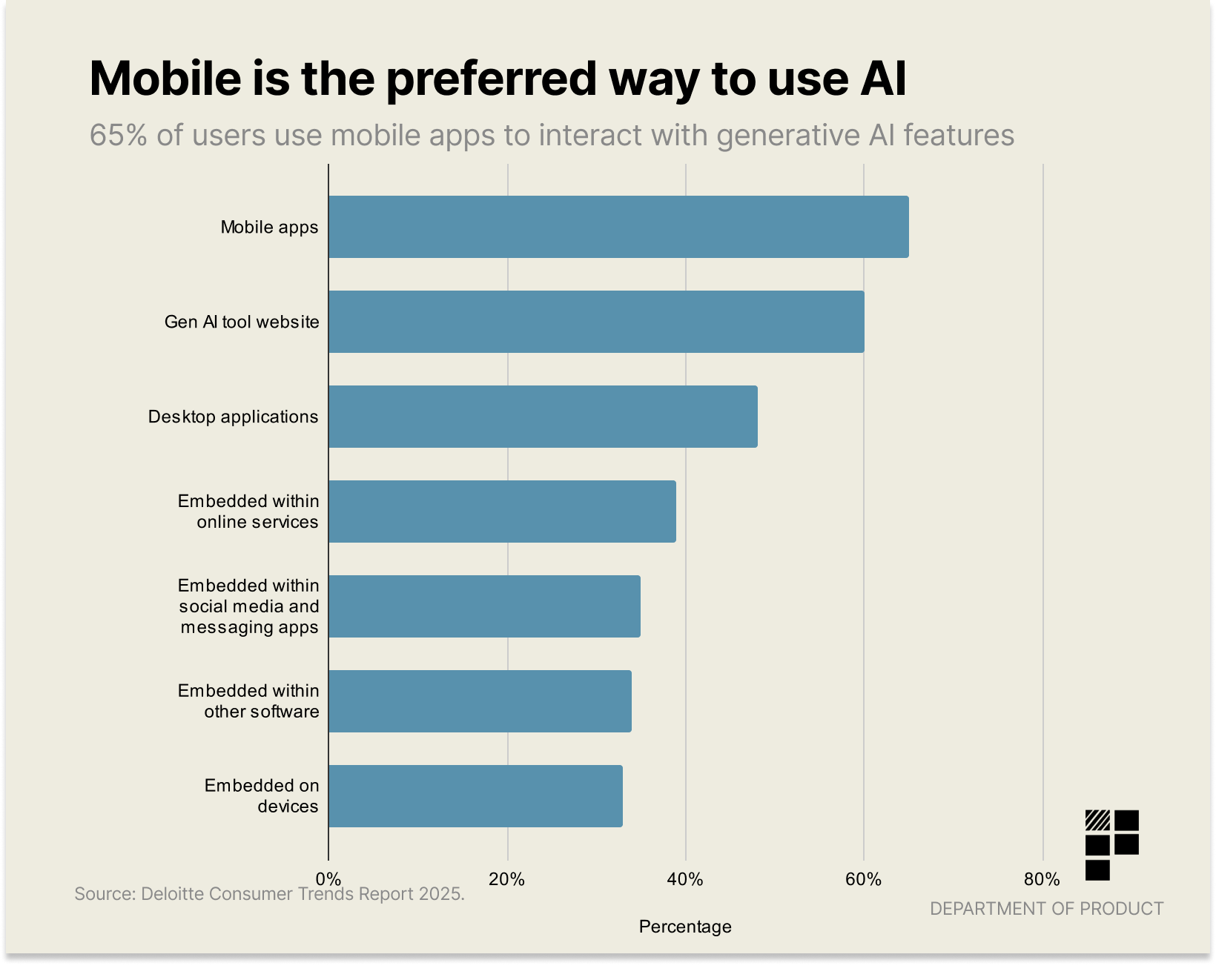
Mobile is the most common device users are interacting with generative AI product and features according to the latest Consumer Connected Survey from Deloitte. This survey included a panel of 3,500 US consumers and asked them about how they’re currently using AI and it’s full of interesting nuggets.
34% of respondents say they now use AI for work - up from 6% just 2 years ago
65% of users access generative AI through their phone - the biggest percentage of all access types
75% say that the technology is improving their lives in some way
29% of respondents plan to increase their spending on generative AI services
One company that’s keen to see more spending on generative AI services is Amazon. And this week, Amazon’s product chief Panos Panay told audience members at their latest product launch that Alexa+ users are using the voice assistant more than twice as much as before and that usage for tasks like shopping and streaming music has increased.
But new data from YouGov shows that the average American consumer at least, isn’t sold on the idea of AI shopping assistants.
OpenAI posted an operating loss of $7.8 billion in the first half of the year but it generated $4.3 billion in revenue in the first half of this year, 16% higher than its total revenue in 2024. The company projected it would burn $115 billion through 2029 before generating cash in 2030, thanks to its projected cost of about $450 billion for servers.
Accenture is laying off 11,000 workers and is prioritising the exit door for people where upskilling in AI is “not a viable path”. A pretty harsh reminder of the consequences of not becoming AI fluent in 2025.

Paid subscribers get the full DoP Substack including: The Knowledge Series for sharpening your tech skills, AI tutorials for putting AI into practice at work, the AI prompt library and DoP Deep dive reports to learn from the world’s top tech companies.