🔵 OpenAI’s new Apps: the next major distribution channel for product teams?

Plus: Google’s new model takes over your computer, Cursor’s new mode could mark the end of planning, Square’s AI Assistant gets voice capabilities...
Hi product people 👋,
This week, I take a closer look at major new announcements from OpenAI and what they could mean for the future of product distribution. Plus, a tool that promises to become your AI product manager, the top 50 AI apps companies are spending on, and a new report showing that internal apps are no longer built only by engineers.
Happy Friday and have a great weekend!
Rich
Watch on YouTube | Follow on Substack Notes

OpenAI wants to build a new AI operating system - but do users want it?
The most significant announcement from the week was OpenAI’s launch of Agent Kit and ChatGPT Apps. Agent Kit allows developers and non-developers to use a drag and drop interface to build agentic workflows that can then be published on the front end. Developers notoriously dislike drag and drop interfaces so it does feel as though this is more of a developer-adjacent product which could enable non-engineering folks to build useful workflows (something OpenAI admits in its own marketing materials).
And the launch of Apps lets ChatGPT connect with products including the likes of Figma and Spotify which could transform how users interact with everyday products. DoorDash’s CEO said “It’s better if customers came direct, but [apps in ChatGPT and similar offerings] are likely additive and so help drive more commerce through the platform”. And one VC at Andreessen Horowitz likened the launch as important as the launch of Apple’s App Store in March 2008.
This seems overly optimistic at this stage; I’m old enough to remember the App Store launch in 2008 but I’m also old enough to remember OpenAI’s previous attempts at building something similar with GPTs back in 2023. ChatGPT has 800 million+ users but this doesn’t necessarily mean they will all want to use it to connect with other products through a single interface. According to the latest research, most current use cases for ChatGPT include activities that involve “Asking” rather than “Doing”. OpenAI will be hoping users will instinctively learn to “Do” more with these app launches but there is no guarantee that users will actually want to use ChatGPT in this way.
For product teams, this certainly has the potential to open up a major new distribution channel to reach users inside their chats in ChatGPT. Some argue that product teams should jump on board the channel right now and start building ChatGPT apps to gain a first-mover advantage but on the flip side, given the relative failure of previous efforts to create a Super App, doubling down on building ChatGPT apps right now prove premature. See my full analysis on the launches here.
Google’s Computer Use model can perform CRM tasks
Google has unveiled a new Computer Use model that is capable of interacting with user interfaces and beats other similar models with a score of 69% vs 55% for Claude Sonet 4.5. Gemini 2.5 Computer Use can perform actions in the browser that could be of interest to product teams, including automatically updating CRM data and even organizing digital sticky notes after a meeting.
Cursor has introduced a new mode called “plan mode”. Unveiled by product manager, Andrew Milch, the new mode allows the agent to gather all of the context it needs by searching external files and other assets before coming up with a detailed plan of action. In plan mode, the agent interacts with the human user to ask questions about the feature that’s been requested before proceeding to the next step. Cursor says that most of the company’s new features are now started with plan mode. See it in action here.
In other news…
Ring has introduced a novel and rather heartwarming new AI-powered feature. It’s called Search Party and it’s designed to help dog owners get reunited with missing pets. When a dog goes missing, Ring will use footage from local cameras in the area to search for images matching the dog. Ring owners will be able to decide whether or not to share the data before it gets sent to the owner but some users have criticised the company for switching the feature on by default.
ElevenLabs has unveiled a series of new UI components designed to be used for product teams who want to add audio-based AI agents into their products. The gallery includes multimodal customer service chat tools, audio visualisers and more. The company also revealed its own drag and drop AI agent builder which allows product teams to map out audio-based AI customer support agents.
Square is making use of AI voice technologies in its latest new feature. This week, the company released the ability for sellers to take orders using AI voices. Prospective customers can call up to speak directly to these agents and ask deep, specific questions about products.
Key reads and resources for product teams
New from the Department of Product:
Knowledge Series - What is ACP? Agentic Commerce Protocol Explained
The new protocol already has the backing of ecommerce giants like Shopify and Etsy, and could soon become the de facto standard for product teams looking to integrate their products into AI agents beyond ecommerce. But what exactly is ACP? And what are the most important parts of ACP worth knowing right now?
New prompt in the AI prompt library - Innovation Strategy Expert
This prompt will help you to develop your product’s strategy by applying the principles from the legendary book, the Innovator’s Dilemma. It forces you to systematically teach yourself each of the principles from the book and consider how they might be used to solve a specific problem you’re currently facing at work. (Department of Product)
Report - The top 50 AI apps companies are spending on today
A new report from Andreessen Horowitz looks at what AI apps companies are spending money on. The list includes the usual suspects like OpenAI and Anthropic, as well as some other products you might not have heard of. (A16Z)
UX - How to embrace design dialects in product design
Design systems aren’t component libraries—they’re living languages. Tokens are phonemes, components are words, patterns are phrases, layouts are sentences. The conversations we build with users become the stories our products tell. Written by Figma’s design advocate Michel Ferreira. (UX design)
Product strategy - The 7 most powerful product moats in 2025
Investors at Y Combinator examine the seven powers framework and examine how these strategies hold up in today’s world of AI powered companies. (Y Combinator YouTube)
Process - 3 principles Anthropic’s product team uses for building great AI products
AI has reset the gameboard for software- if you’re using AI all day and you build something for yourself, there’s a good chance no one’s ever done it before. and if you build for yourself, you can just follow your taste and intuition for what to make. (X)
Autumnal reading

Tools you can use
Squad - calls itself “Your AI Product Manager”. Promises to analyse your data, surface insights and build your product roadmap.
Lorikeet - a new type of customer support tool, founded by former product leader at Stripe. Interacts with users across chat, email and voice.
Clay - uses AI agents, enrichment and intent data together to let you perform super intelligent product market research.
📈 Product data and trends to stay informed
65% of internal products are now built by non-engineers. In a new survey conducted by SaaS company Retool, they found that just 35% of the apps built using its AppGen product were by engineers, with the rest built by Ops Leaders, Product Managers, Data Scientists and others.
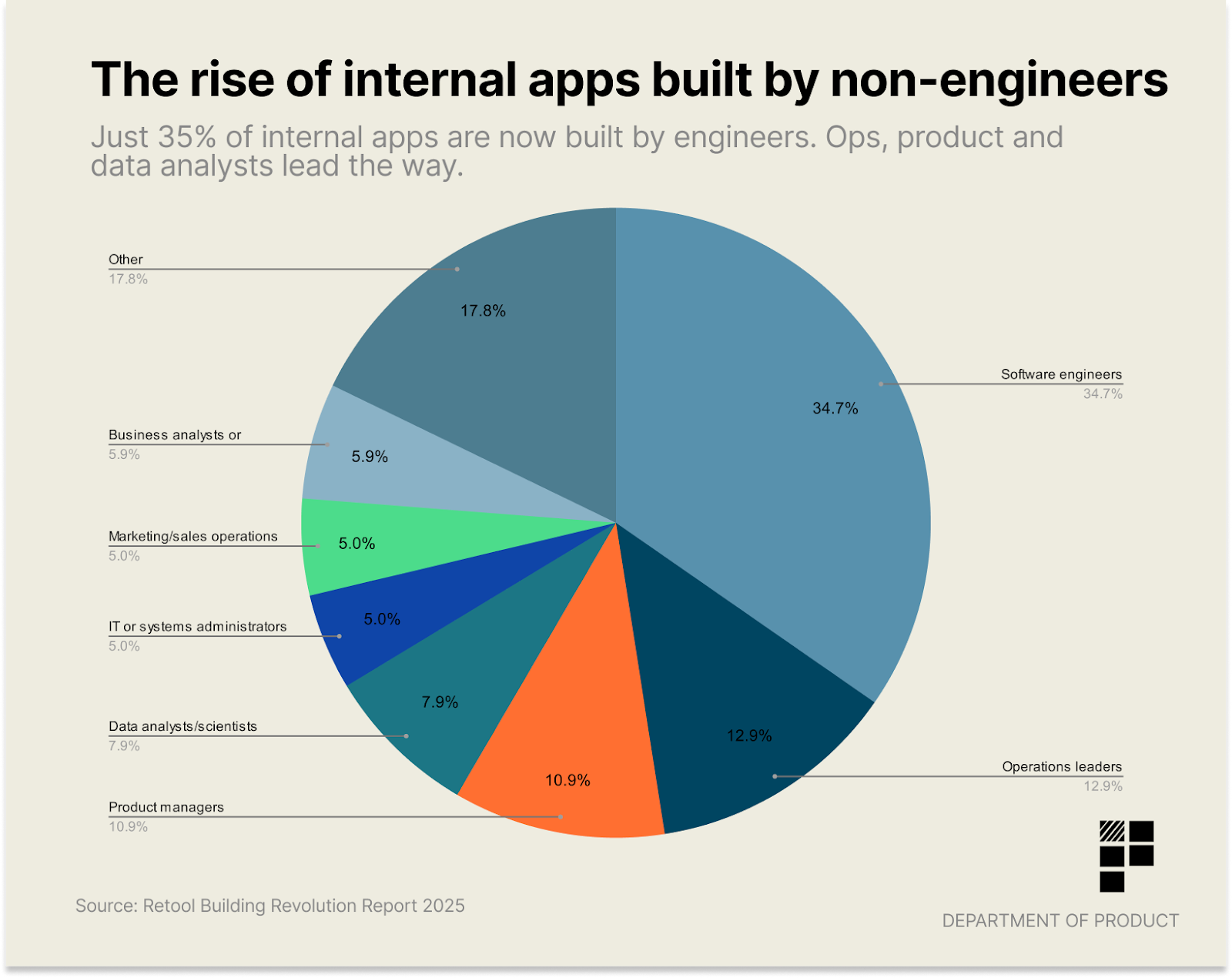
Since the study was conducted by a low-code platform, we should factor that into the equation; a low-code platform will naturally attract non-developers because they are a key user segment for no code tools. But, the numbers are pretty interesting nonetheless.
The report also include some other nuggets on how vibe coded internal apps are impacting businesses and workers:
46% of internal tool builders are recognized by leadership as someone who can “make things happen”
80% of builders say they can go from problem identification to solution implementation without additional support
Most internal tool builders are leadership or management level (31%)
A leaked memo from Meta shows that the company is rolling out a new vibe coding tools aimed at reducing deployment times from 99 minutes to two minutes or less. New analysis shows that the initial crop of vibe coding tools are suffering a post-Summer slump.
Sora 2 has hit the number one slot on Apple’s App store with 627,000 downloads and while AI slop may be taking over social media, advertisers are losing interest. Brand partnerships with AI social accounts dropped by around 30% in the first eight months of 2025 compared to the same period in 2024.
The co-founder of Notion says the company now has over 300 different custom built AI agents that work alongside its employees. One of these is an agent that tracks internal feedback about new product changes and automatically logs and triages.
The FT has published a new data visualisation piece which shows how we’re using AI. One of the data points includes this chart which ranks countries based on AI usage. UAE, Singapore and Norway top the list.
Deloitte has been forced to refund the Australian government after a 237 page report contained non-existent footnotes and references that were AI hallucinations.
Paid subscribers get the full DoP Substack including: The Knowledge Series for sharpening your tech / AI skills, the AI Prompt library and DoP Deep dive reports to learn from the world’s top tech companies.