🔵 Claude gets Skills and Google Sheets' new AI function lets product teams track real time user feedback
Plus: A 300 page State of AI 2025 report, Gemini 3.0 leaks, How Linear's head of product uses AI agents to ship changes without disrupting engineers...
Hi product people 👋,
This week, I take a look at the latest release from Anthropic’s Claude, which some speculate could be more impactful than MCP. Plus, insights from the 300 page annual State of AI report, Google Sheets’ new AI function capabilities and Linear’s head of product reveals how AI agents let product managers, designers and non-engineers ship simple changes without disrupting engineers.
Happy Friday and have a great weekend!
Rich
Watch on YouTube | Follow on Substack Notes
Anthropic upgrades agents with Skills
Anthropic has launched a new capability in Claude called “Skills”. Anyone who has used an AI browser will be pretty familiar with this concept but Claude’s Skills are slightly different. Skills are re-usable snippets designed to help AI Agents achieve specific tasks more effectively. For example, you might use a brand guidelines Skill to generate PowerPoint decks and Word docs that auto-apply approved templates, fonts, and tone. Or you might use an image editing Skill to automatically edit images uploaded directly into Claude.
Here’s an example of it in action where a Skill is used to grabs data from a CSV and transform it into a Powerpoint presentation. Simon Willison argues that the simplicity of Skills may ultimately make them a bigger deal than MCP.
Walmart has confirmed a major partnership with OpenAI’s ChatGPT that will allow users to buy products through its new Agentic Commerce Protocol. ~40% of Walmart’s revenue is online ($240 billion). Will Walmart’s customers want to make purchases through a conversational interface rather than browsing a store? Not everyone is convinced, but this will be a big test for consumer appetite.
Linear has published a page with a list of all of the AI Agents that the company now supports. These include agents for logging and fixing bugs, writing requirements and more. And this week, their head of product revealed how the company uses AI agents internally to help them to ship small, non-controversial changes like changing text or updating colors that would otherwise disrupt the productivity flow of an engineer. A product manager or other non-technical person can write up a spec, delegate it to the AI Agent and push it to production. He says that the litmus test they use for determining which tasks to delegate to AI Agents are non-controversial changes that are easier to do than asking an engineer to context switch but the company’s product teams also use it for testing out ideas that may not get shipped. A smart way of shipping simple changes without interrupting engineers.
Google 3.0 Leaks and Sheets gets more AI upgrades
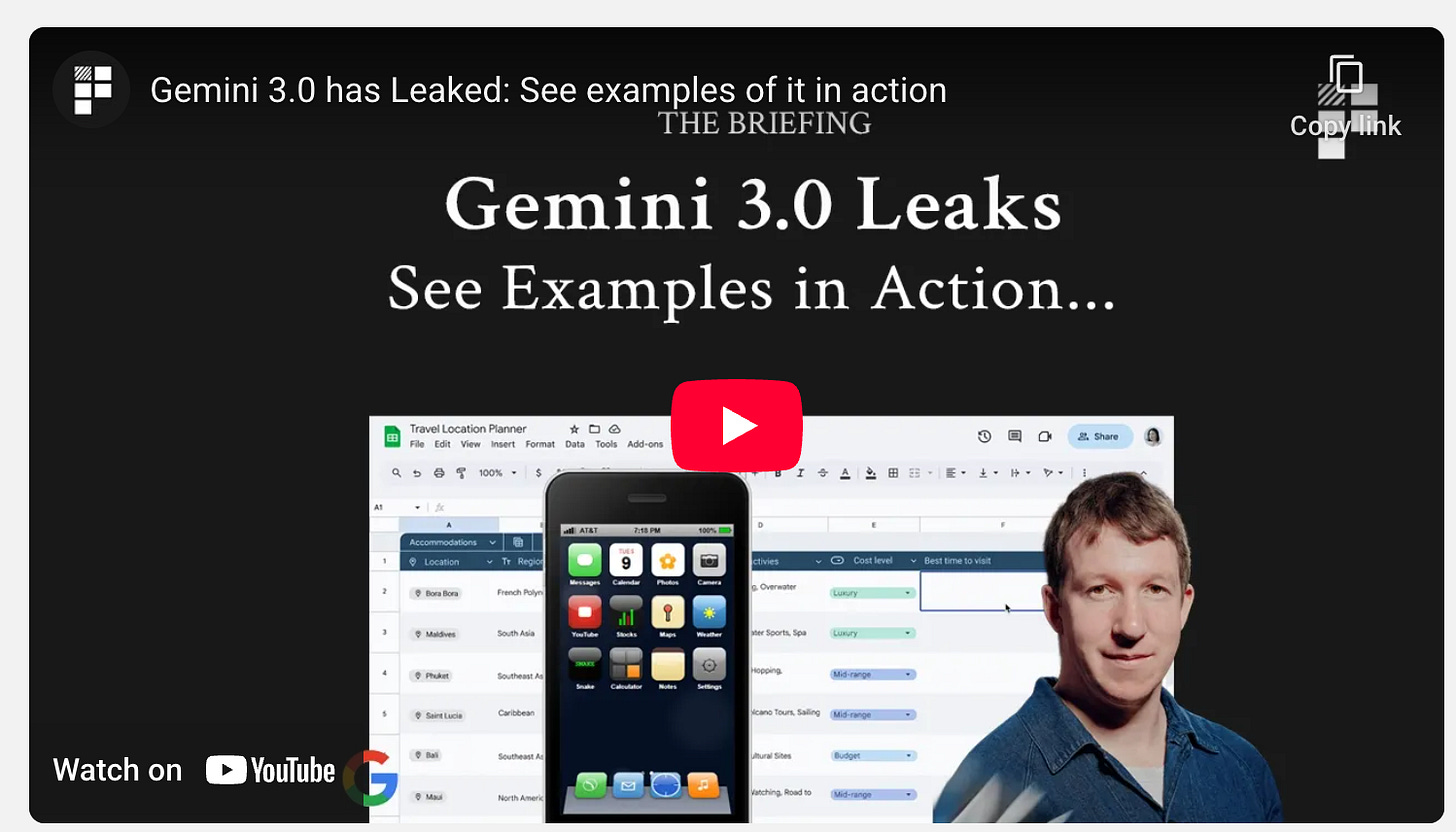
Gemini 3.0 leaks have started to emerge with rumours suggesting that Google’s new model could be ready for release within a few weeks. Here’s an example of it vibe coding and another of it creating an iPhone operating system in one shot.
Google’s Nano Banana image editing model is being rolled out across more Google products, including Search and NotebookLM. In Google Search AI mode, users can upload photographs and edit them with Nano Banana through Google Lens and in NotebookLM Nano Banana is powering Video Overviews.
Google has also introduced some new Workspace updates this week that could be of interest to product teams. The first is a new “Help me Schedule” feature in Gmail powered by Gemini which is designed to make it easier for you to find a meeting slot with a colleague. The other is a new update to Google Meet that will automatically add makeup to your face. Google’s product lead gave a demo of how to use the different filters inside Meet. As well as this, Google also updated its AI function in Sheets that was released earlier this year. The new updates make the AI function mode powerful by automatically adding real time results from Google Search. One of the examples Google suggests is using the function to track real time customer sentiment after a product launch.
In other news…
YouTube is rolling out some visual changes to its player that it says is designed to make the player easier to navigate and “cleaner and more immersive”. The update includes new iconography with rounded edges, new UX for saving videos and a threading system for replies. But why is the volume control button so small?
Spotify is adding new conversational UX to its DJ feature. After adding voice requests earlier this year, users will now be able to make DJ requests in text, too. Spotify says that since their roll out, conversational voice features have boosted engagement with DJ.
Key reads and resources for product teams
New from the Department of Product Substack this week:
Deep - The Powers of AI Assistants
In this Deep Dive, we’ll take a closer look at the latest crop of in-product AI Assistants to understand what powers they have today and how product teams at some of the world’s leading tech companies are introducing the latest agentic technologies into their AI Assistants. For each Assistant you’ll get a summary of their capabilities along with UI examples that you can use to inspire your own product’s Assistant.
New mini app and prompt added to the library - North Star Metric builder
Use this mini app to systematically identify your product’s North Star Metric. This mini app will ask you to input all of the relevant details including your product’s “Aha” moment as well as the breadth, depth, frequency and efficiency of your metric. And then share it with stakeholders.
(Department of Product)
Analysis - The new trillion dollar AI tools that are transforming the software development process
In-depth analysis from Andreessen Horowitz explores the new crop of AI tools that are transforming the software development process. AI shifts product development into an agentic, iterative loop where LLMs co-own the lifecycle—from planning specs and gathering requirements to coding, testing, and documentation—guided by company-wide rules and rich context. (Andreessen Horowitz)
Strategy - How to let AI do product onboarding for you
AI can model how to use a product by actually going through the process of creating something and letting people watch. From there, people can just tweak the result to get closer to what they want. AI does the creation, people do the curation. (Luke W Design)
Perspectives - Why personal software doesn’t need product market fit
We’re witnessing the emergence of a new software layer. At the base are the professionally-built, robust systems that power our world: databases, operating systems, and rock-solid frameworks. In the middle are commercial applications built for broad audiences. And at the top, a new layer is forming: millions of tiny, personal tools that solve individual problems in highly specific ways. (Karan Sharma)
Process - How to boost your company’s AI maturity level
Organizations that are AI mature outperform early-stage AI implementers — but many companies struggle to advance from AI pilots to AI at scale. (MIT)
Case study - How Uber built an automated code review system that saves developers 1,500 hours per week
Uber’s custom built, AI-powered code reviewer reviews ~10k commits weekly within a median 4 minutes and saves about 1,500 hours per week. In this post, Uber’s engineering teams explain how they built it and how it works. (Uber)
Tools you can use
Flint - backed by Sheryl Sandberg, helps teams build what it calls “Autonomous Websites”. In other words, sites that generate, adapt, and A/B test pages themselves based on visitor behavior, market changes, and AI agent traffic, while preserving brand fidelity.
Strawberry - a “self-driving browser” that comes with a team of AI companions, each with their own persona, including “Competition Camilla” for competitive analysis and “Recruiter Ryan” to help you hire. This week raised $6 million.
Cyrus - Transform Linear issues into production-ready code with Cyrus while you direct.
📈 Product data and trends to stay informed
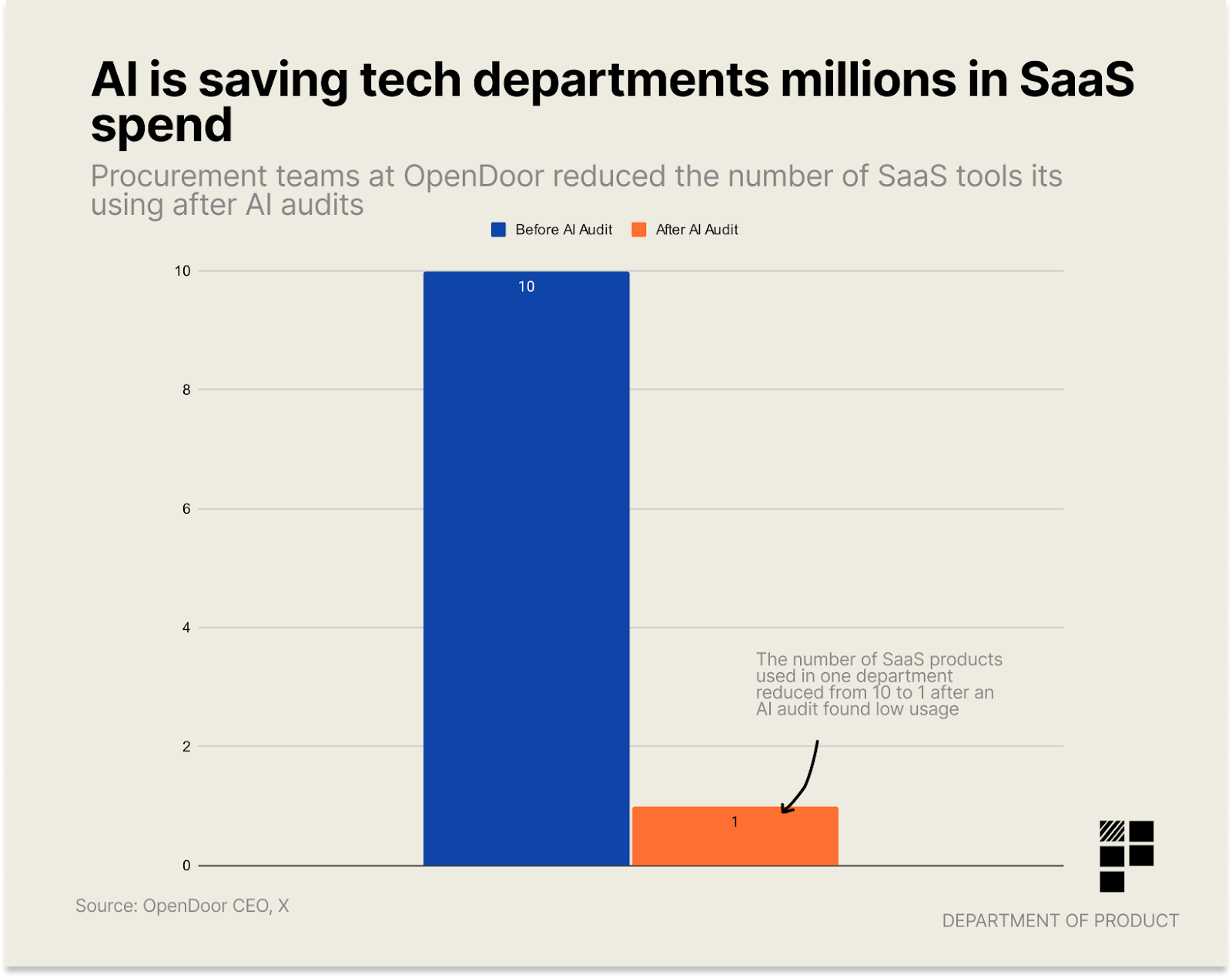
OpenDoor’s procurement team has saved millions of dollars a year by cancelling SaaS contracts for products they don’t use. Their CEO says they’ll soon go from paying 10 different SaaS providers in one department down to just one after an AI audit of SaaS product usage. Excellent news for CFOs, not quite so exciting for the SaaS companies.
This week, the annual State of AI Report 2025 was released from Air Street Capital. The report is over 300 pages long but here are some stats worth knowing for product teams.
Claude and Cursor are the most adopted tool this year, while ChatGPT and Perplexity are the most dropped
Langchain is the most popular framework for building AI agents
The average contract value for an AI enterprise software product has grown from $39,000 in 2023 to $1 million in 2025
AI-first companies are growing from launch to $5m ARR at a 1.5x faster rate than the top 100 SaaS companies in 2018
MCP is the most adopted protocol for AI Agents with an estimated 15,000 servers globally
Stripe says they’ve seen a 32% week on week growth in the number of users of its MCP with the top MCP use cases including searching product catalogs, creating or retrieving prices and reading docs.
57% of companies now have AI agents in production with 8% of agents gaining “total autonomy” with no guardrails. Security and DevOps are the leading use cases for these high autonomy actions. New report on AI Agents in practice.
Almost 60% of small European tech companies say they have experienced delays in rolling out new AI product features due to regulation vs 44% in the US. One-third of European developers at small tech companies had to remove or downgrade features to comply with requirements, largely due to data handling and safety checks.
Claude Code and OpenAI’s Codex are now neck and neck for coding pull request approvals at 74% each but neither of them top the current leaderboard.
Anthropic’s co-founder has warned humanity about the risks of AI, saying that “what we’re dealing with is a real and mysterious creature”. He argues that as systems become more sophisticated, they also become more aware that they’re being tested. But David Sacks says this is nothing more than a “sophisticated regulatory capture” strategy, based on fear mongering.
Paid subscribers get the full DoP Substack including: The Knowledge Series for sharpening your tech / AI skills, the AI Prompt library and DoP Deep dive reports to learn from the world’s top tech companies.