🔵 Linear’s CEO says this is the best feature the company has ever created
Plus: ChatGPT Atlas, How to give your product legitimacy, Spotify and Pinterest’s AI slop filters...
Hi product people 👋,
In this week’s Briefing, OpenAI’s CEO of Applications shares her vision for the latest AI browser, ChatGPT Atlas, Linear reveals a new feature for product teams that its CEO believes is the best ever created and a new prompt in the AI prompt library you can use at work for crafting your product strategy.
Happy Friday and have a great weekend!
Rich
Watch on YouTube | Follow on Substack Notes
Key reads and resources for product teams
New from the Department of Product Substack this week:
Knowledge Series - What are Claude Skills and how can you use them at work? How to create a backlog of 42 user stories in 10 minutes.
Claude Skills are seriously impressive. In this Knowledge Series, learn about what they are, how they work and perhaps most importantly, how to use them at work for tasks including creating presentations, building Excel spreadsheets and automating your end to end product development process. One Skill was able to build an entire backlog of 42 user stories with acceptance criteria in 10 minutes.
New prompt in the library - Use the 7 Powers framework to craft your Product Strategy
The Seven Powers is one of the world’s leading books on developing successful strategies. Use this prompt to systematically craft your own product’s strategy by applying some of the core principles from the book. A mini guidebook on the 7 Powers is also included, along with instructions on how to customize the prompt to add context from your own product.
(Department of Product)
Resource - Perplexity at Work: A 42 page guide to using AI at work and getting more done
Perplexity published a hands-on guide on how to use AI at work. The guide focuses on 3 different themes: focus for reclaiming your attention, amplification for integrating AI into your existing workflows and outcomes for achieving concrete and recognised goals. The guide is Perplexity-specific but the principles and ideas can be applied across other AI tools, too.
Strategy - How to give your product legitimacy
Legitimacy - not just usefulness - determines whether software gets adopted, and its signals have shifted over time. From SIGs/User Groups and RFCs in the 60s–70s that conferred technical credibility, to magazine and newspaper kingmakers in the 80s–2000s. (Andreessen Horowitz)
Skills - How to cultivate an experimental mindset in your company
Harvard Business School’s Stefan Thomke says running experiments can give companies tremendous value, but too often business leaders still make decisions based on intuition. With the right approach, even small firms can get a competitive advantage from the right kinds of tests. He explains how to introduce, run, and learn from experiments. (Harvard Business Review)
Process - How Gamma’s product team uses the “one day loop”
Described by Lenny as the “fastest loop I’ve ever seen”, Gamma’s product teams are going from ideas to prototypes in record speed. (X)
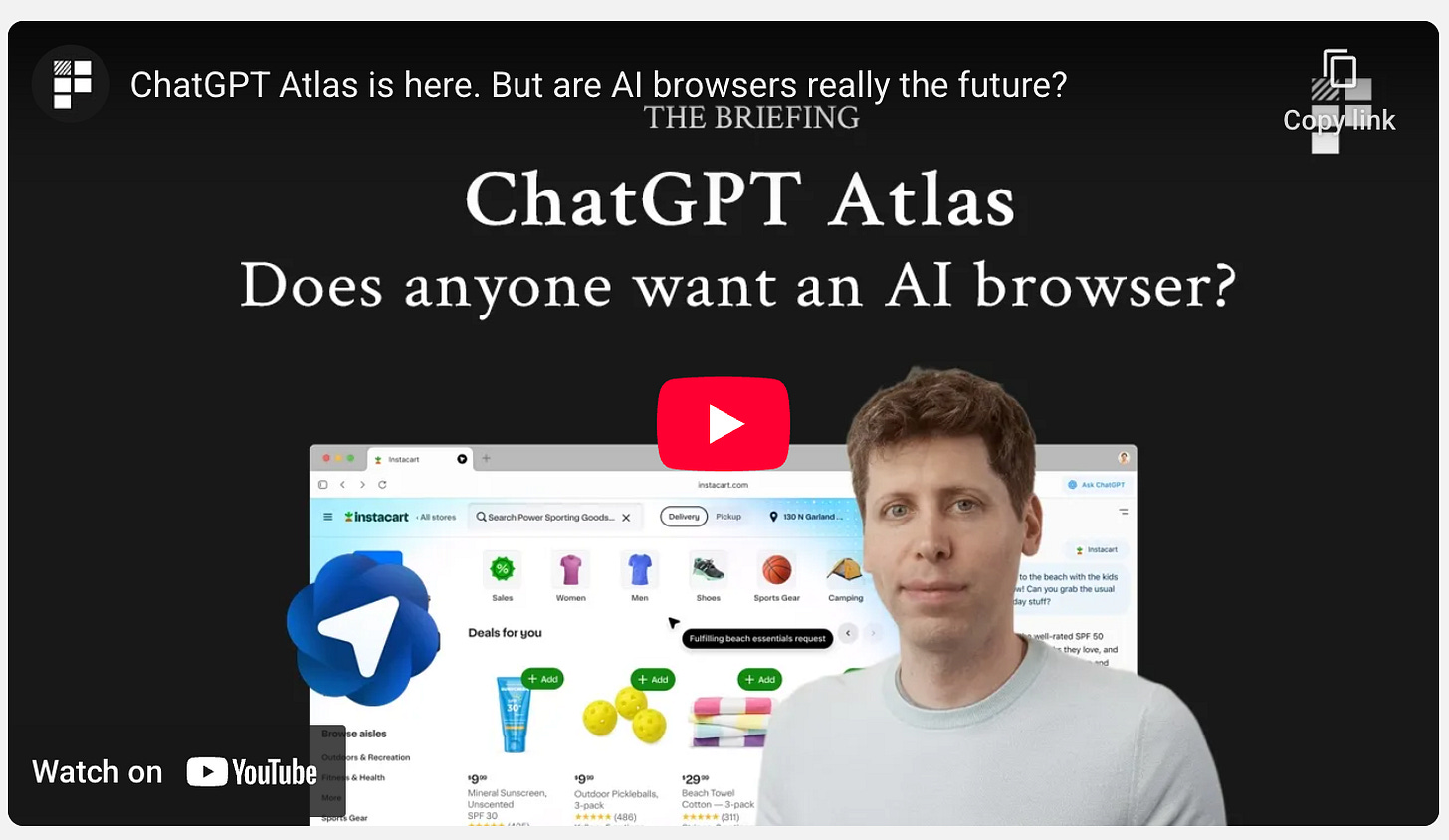
OpenAI joins the AI browser race but are AI browsers still the future?
After months of rumours, OpenAI finally confirmed that it was building a browser with the release of ChatGPT Atlas. It’s a new Chromium based browser that does pretty much what other competitors like Dia and Perplexity’s Comet do with a built-in agent and Assistant.
Speaking on her blog, OpenAI’s new CEO of Applications Fidji Simo says that the ultimate vision here is to create an AI powered operating system with ChatGPT at the core. “Over time, we see ChatGPT evolving to become the operating system for your life: a fully connected hub that helps you manage your day and achieve your long-term goals.”, she said.
But do users really want AI powered browsers?
Since the launch of Dia and Perplexity Comet earlier this year, Google Chrome’s market share has actually increased - up from 64% to 74% year on year. Even with an install base of 800 million+ users, ChatGPT is facing an uphill struggle to convince users to switch. And the security risks of AI browsers are still very real. This week, Brave published new research on the vulnerabilities it found in Comet and other AI browsers. But, as someone who has loved using Dia for the past few months, I’m still a firm believer in AI browsers - it’s just that Chrome is likely to emerge as the inevitable winner, unless ChatGPT can pull off something spectacular.
If you want to learn more about how you can use AI browsers at work, check out the Knowledge Series on that.
Linear’s CEO says this is the best feature the team ever created
Linear has released a new AI Agent for Slack which will automatically create issues that are informed by your conversation’s context. So, for example, if a colleague drops a message into a chat that describes functionality that isn’t working as expected, Linear’s bot will recognise this as a bug and create the necessary engineering tasks to fix it. Their CEO says that this is the “best feature the team ever created”.
Yelp unveiled a series of impressive new capabilities this week, too. Menu Vision lets users scan a menu with their camera to reveal user reviews of that dish to help them decide what to order and the company also released two new AI voice assistants: Yelp Host and Yelp receptionist. Both are voice powered AI assistants that will talk to customers in real time 24/7 to answer questions and also perform actions on their behalf. Yelp Host, for example, will book a table, send SMS follow ups to confirm bookings and take notes on any additional requirements that might be needed such as dietary requirements or child-friendly seating. For product teams whose users rely on humans to perform tasks that distract them from value adding activities, these new types of voice powered AI Assistants could be transformative.
Vibe coding updates from Anthropic and Google Studio
Claude Code is now available on the web which means that engineers can offload work to agents when they’re on the move and Google has updated its AI Studio to incorporate new vibe coding capabilities. You can now use Google Studio to incorporate generative AI models (Veo 3.1 Nano Banana), text-to-speech and other models in one single interface. Google’s Logan Kilpatrick says that more integration features like database set up, file storage and authentication are in the pipeline. Here’s an example of it one-shotting a Windows simulator in 89 seconds.
Studio also got a new “Annotate Mode” which lets you scribble on the screen to describe the changes you’d like to make to your prototypes - super handy as an alternative to traditional the conversational back and forth that can often be pretty frustrating.
AI slop filters come to social products - more on the way?
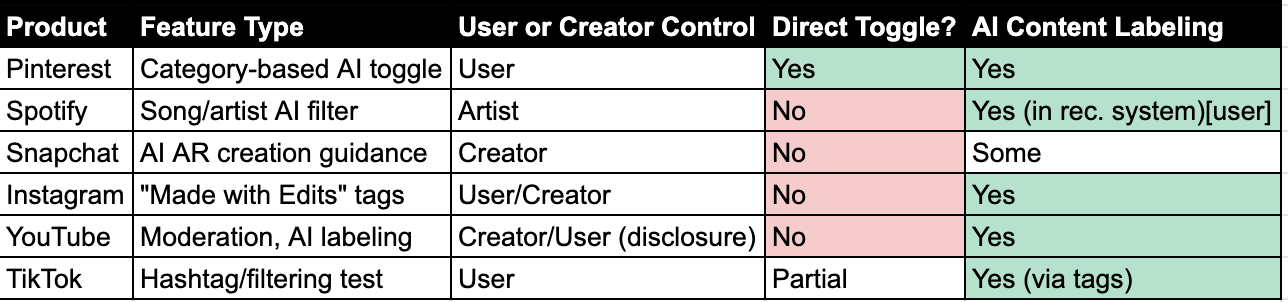
Pinterest has shipped a new set of toggles that allows users to toggle generative AI features on and off. Users are able to decide on a category by category basis whether or not they want to see AI generated content in their feed after the product was flooded with genAI content.
Spotify has shipped its own filters to reduce or eliminate AI slop by identifying AI generated songs and removing them from its recommendation engines. And this week, it confirmed that it was working with artists to give them control about how their music is used in AI training models. A spokesperson said that the new features would be “built fairly, with artists’ permission, presented to fans as a voluntary add-on rather than an inescapable funnel of AI slop”.
Here’s the current state of AI slop filters across different social products:
Tools you can use
Alloy - prototyping for product managers. Build prototypes that look exactly like your product rather than vibe coding from scratch.
Nimo - lets you put all of your productivity tools and AI agents into 1 single intelligent canvas. You can have your Gmail, Google Sheets, Notion and other apps all in one workspace and then use AI across each of these different products to perform different actions.
Jack and Jill - a two way marketplace for finding a job except the market is entirely managed by two different AI Agents: Jack and Jill. This week, they raised $20 million.
📈 Product data and trends to stay informed
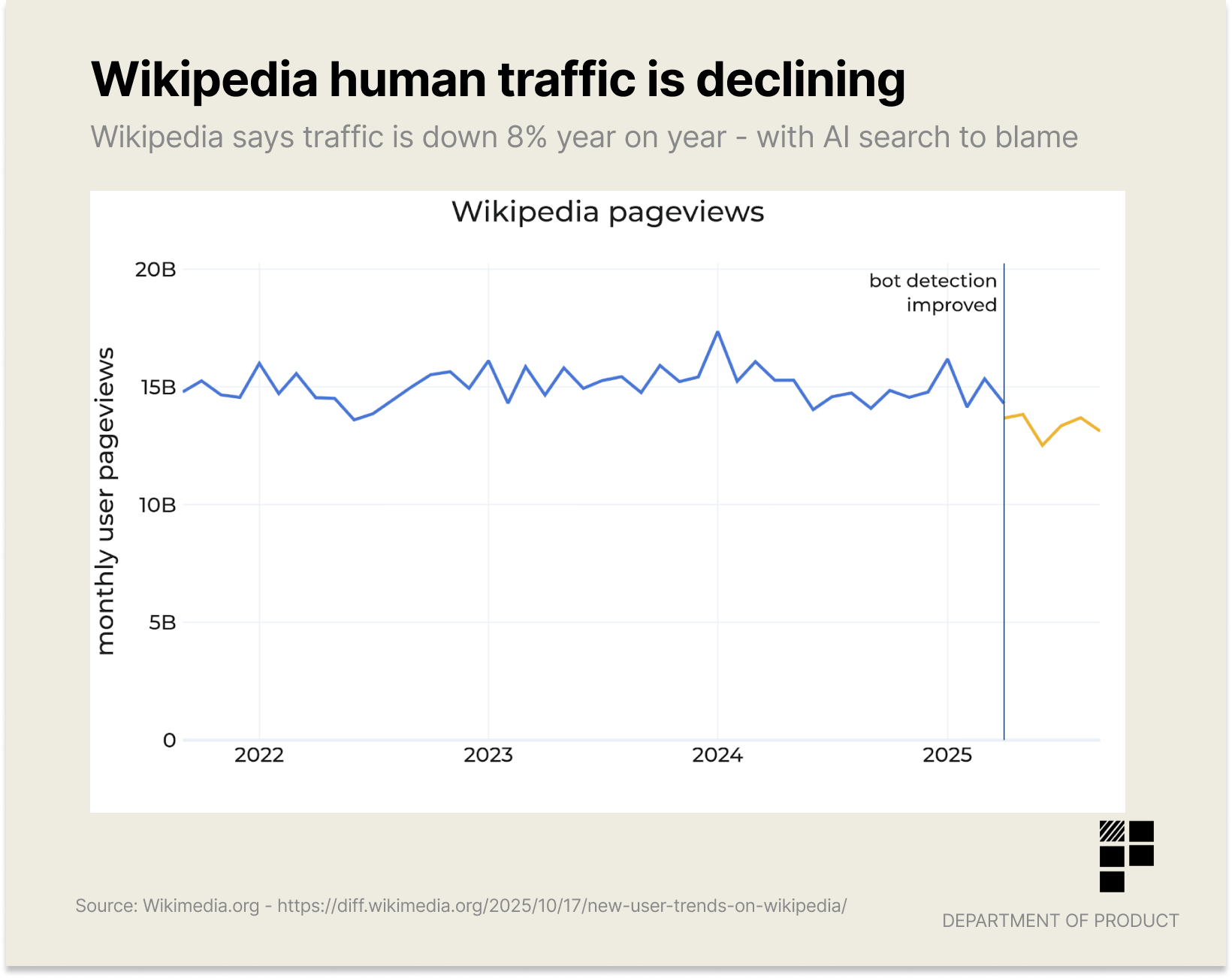
Wikipedia says human page views have dropped 8% year on year, citing generative AI as one of the factors driving the decline. “With fewer visits to Wikipedia, fewer volunteers may grow and enrich the content” they warn in a new piece analysing user trends.
Anthropic’s CEO says that 90% of the code at the company is now written by AI - but engineers remain crucial: “ Claude is writing 90% of the code, what that means, usually, is, you need just as many software engineers. You might need more, because they can then be more leverage”.
Uber exec also echoed this sentiment, saying that he expects the number of drivers to actually increase as autonomous vehicles hit the roads.
One company that seemingly doesn’t share this view though, is Amazon. And this week, according to the New York Times at least, leaked internal documents show that Amazon plans to replace more than 500,000 jobs with robots.
Netflix reported its latest earnings with revenue growth of 17% year on year. Product changes that helped drive the growth included an updated TV UI which is now on 85% of TV devices, a new conversational search that helps users discover titles easily and generative-AI powered localization which boosted retention. Their CEO said that the company is going “all in” on AI.
Paid subscribers get the full DoP Substack including: The Knowledge Series for sharpening your tech / AI skills, the AI Prompt library and DoP Deep dive reports to learn from the world’s top tech companies.