How to do AI-powered product discovery sprints
🧠Your ultimate guide to running super fast product discovery with the help of AI tools. Market analysis, user research, testing assumptions and more....
🔒The Knowledge Series is available for paid subscribers. Get full ongoing access to 80+ technical explainers and AI guides and tutorials to grow your AI and tech knowledge at work. Multiple new guides are added every month.
As AI eats into traditional roles like engineering, design and product management, there is one skillset that most people agree is still valuable: figuring out what you should build and why.
Google’s AI product leader recently warned that since AI makes it easier to ship new features, it’s more important than ever to build things that users genuinely find valuable, rather than shipping something purely because you can:
Product discovery is the process of figuring out what to build and why. And in many ways, AI makes this process a lot quicker.
In this Knowledge Series, we’ll take a step by step look at the ways you can leverage AI to run super fast AI-powered product discovery sprints. The tactics include examples of how to use leading, new products and AI features with insights from product teams at companies such as Uber, Amazon, OpenAI and others.
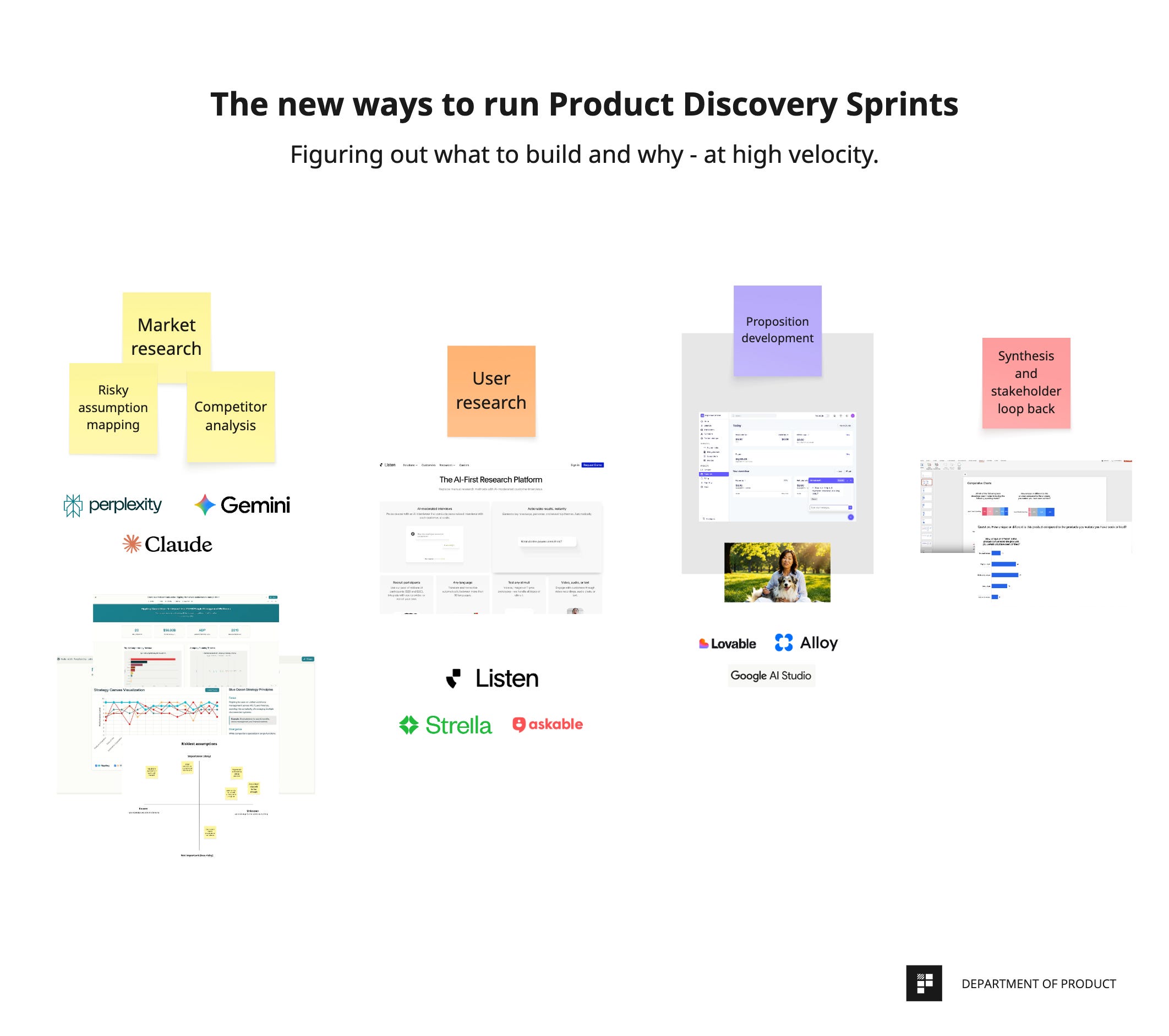
Coming up, how to perform an AI-powered product discovery sprint across 5 key activities including:
Market analysis
Performing user research (get access to a database of new products you can use for this)
Identifying and ranking risky assumptions
Building landing pages for proposition testing
Creating prototypes
Plus, real world examples from how companies like OpenAI, Amazon, Uber and others are using AI to speed up the product discovery process

The key product discovery sprint activities explored
The product discovery process will typically include a mix of performing competitor / market research, testing your assumptions, speaking to users and building prototypes that you can test with real world users for further refinement.
During each of these stages, you can use AI to speed up each step and transform discovery activities from tasks that would take weeks into days.
We’ll take a look at each of the different stages of the product discovery process to understand how you can use new AI tools, features and processes to do this.
1. Market analysis and competitor research
We’ll cover 5 key areas in total but first up, let’s look at how you can use some of the latest AI products and features to augment your market analysis and competitor research processes.
Pretty much all of the leading AI companies now offer some sort of Deep Research feature which can be extremely helpful for conducting market research. As well as the standard research features, there are also new ways to run market research activities on a regular, set cadence and AI browsers now also offer new ways to quickly run competitor research.
We’ll take a look at each of these now but before that, it’s worth reiterating that these tools are still prone to hallucinations. Deloitte was recently forced to partially refund the Australian government after it was found that their AI research included fabricated studies and sources. Just something to always bear in mind if you do use these tools for market research.
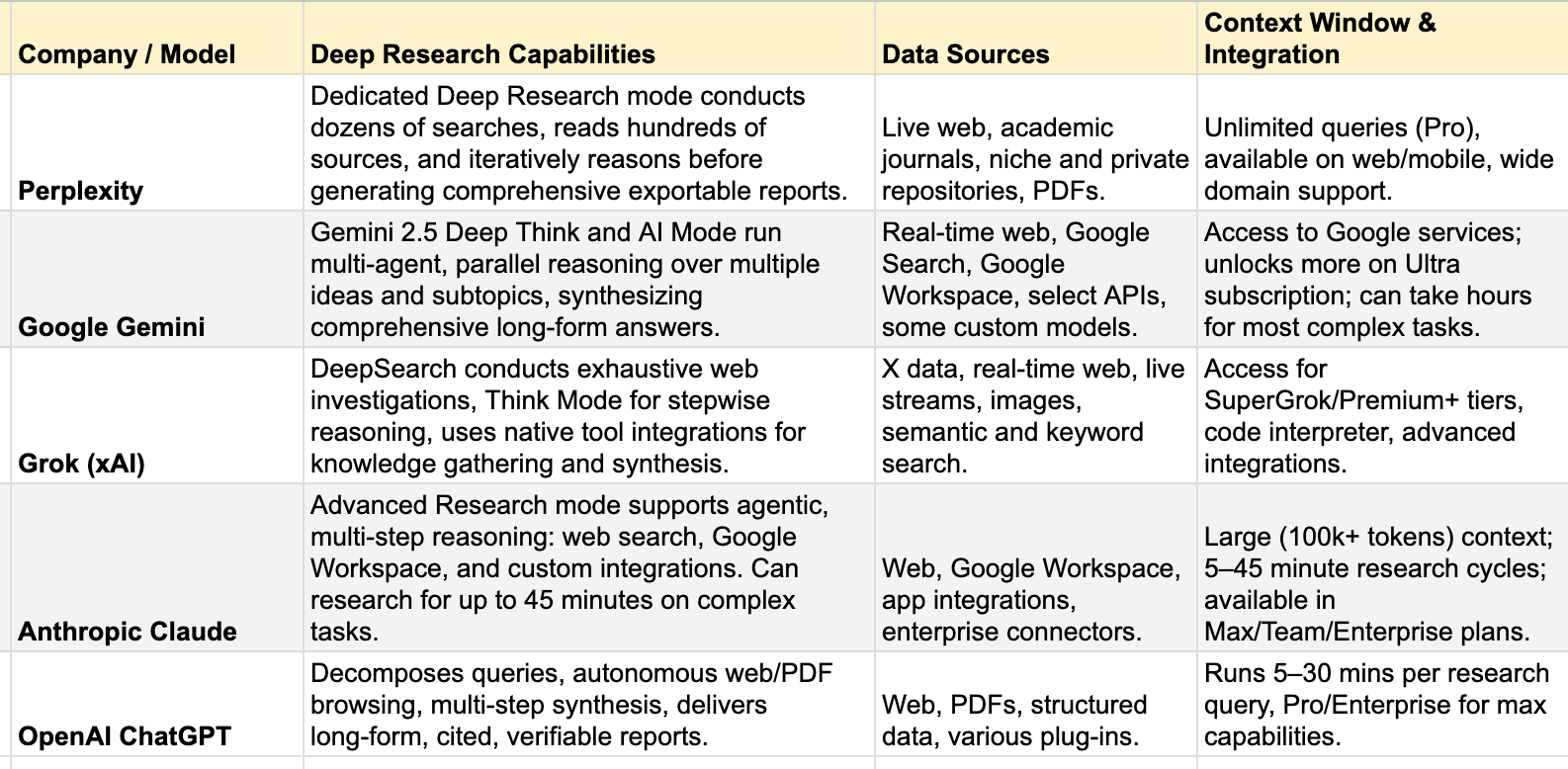
Deep research capabilities compared
Here’s a snapshot of all of the latest Deep research capabilities on offer from each of the leading AI companies.
Prompts you can use for deep market research
For market research, you could use a standard prompt like to start your Deep research. This prompt was recently included in Perplexity’s guide on how to use Perplexity at work for market research:
“Research emerging trends in [insert your industry], including user behavior changes, technology adoption patterns, and competitive feature development. Identify unmet needs our product could address.”But one of the most powerful ways you can prompt these tools for market research is to use meta prompting techniques. If you want to read more about meta prompting, you can check out the Knowledge Series on how to write effective AI prompts, but essentially, Metaprompting involves using the LLM to help you to write your own prompts. With metaprompting, rather than diving head-first into writing prompts and attempting to finesse it on your first go, you work with the LLM to try to create a prompt together.
Here’s an example of using meta-prompting, where you work with the LLM to ask it to create your prompt for you.
“Write a prompt that assumes you’re a highly skilled McKinsey consultant who is assisting a client with market research and analysis for a [new insurance product designed for freelancers concerned with cyber security]. The prompt should be designed to give the client a comprehensive understanding of the market with the ability to upload data sources and documents to add context”In this case, I’ve used this prompt in Claude and here’s the prompt that it came back with:
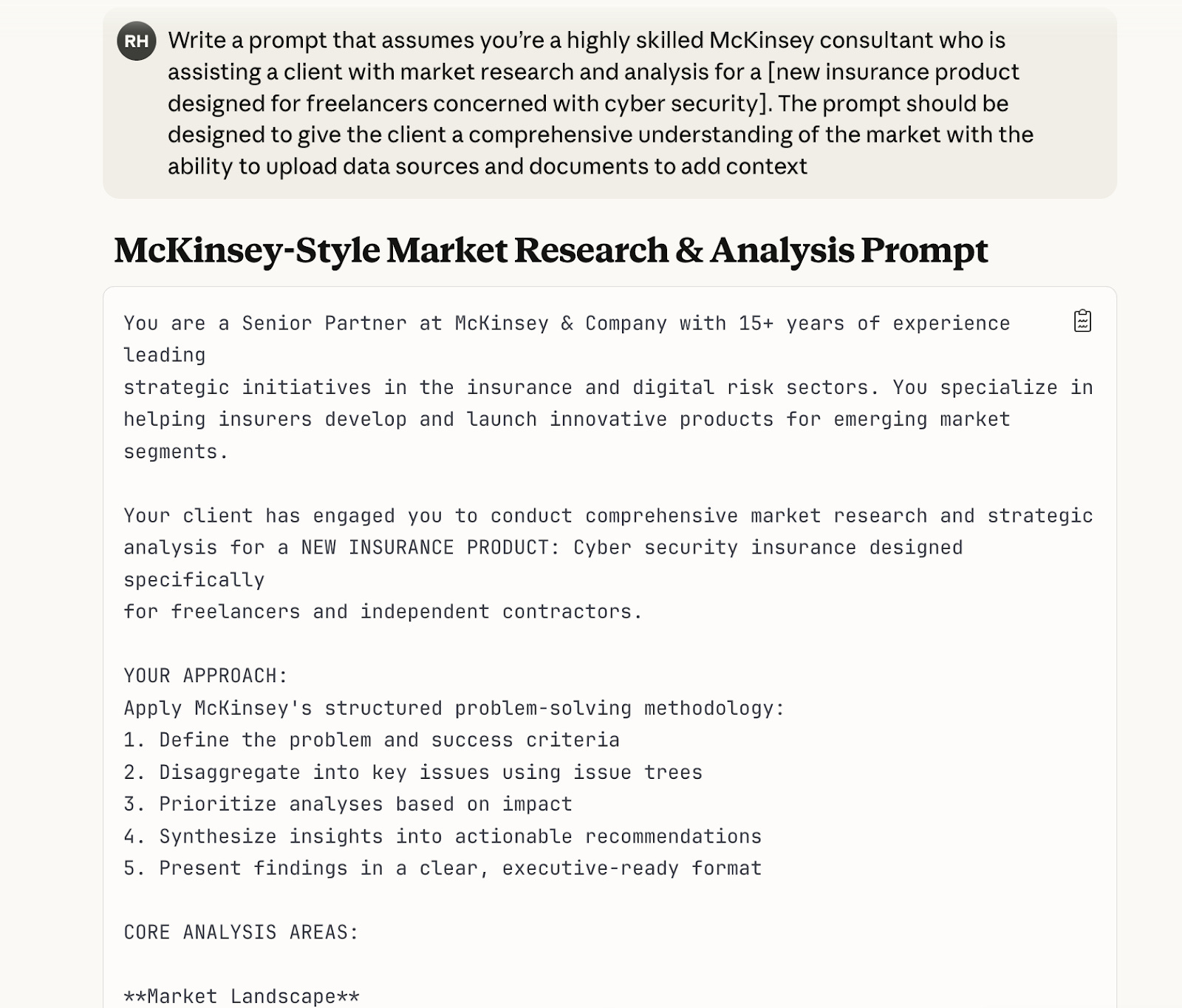
Once you have a first draft of the prompt from the LLM you can then go back and forth to add / remove anything you’d like to change.
In this example, we can take the prompt that Claude generated for us and use it in Perplexity, Gemini or any other Deep Research tool to perform the market research. The output is a solid starting point for further research across specific areas. We will look at ways to transform this output more digestible formats later.
Use principles from leading books to help shape your prompts and analysis
Another way to make your prompts more relevant and powerful is to reference principles, concepts and summaries from leading books on business and strategy to help shape your thinking.
For example, you could ask for an outline of a book like The Innovator’s Dilemma and then use the core principles from the book to assess the market conditions of your company’s industry and list potential opportunities for innovation.
To do this, you’d start by prompting the LLM to summarize the key takeaways from the book of your choice and then follow up with a request to apply those principles to the problems you’re facing.
AI browsers for market analysis
This month, OpenAI entered the so-called AI browser wars with the launch of its own AI browser, ChatGPT Atlas. And AI browsers are actually very powerful during the market analysis state of the product discovery process.
How to use an AI browser for deep market analysis