🔵 Microsoft, Cursor 2.0 and the rise of software development Agent Orchestrators

Plus: Wharton AI Adoption Study reveals whether AI investment is driving ROI, Figma Make gets new prototyping powers, a new mini app for measuring Product Market Fit...
Hi product people 👋,
This week, Microsoft positions itself as the centre of the AI workplace and GitHub and Cursor release new versions of their developer tools which could ultimately transform the engineering process. Plus, a new feature from Figma that makes prototyping a lot easier, a database of 6,000 MCP servers to potentially use in your own product, and a fascinating new study that shows why AI agents are nowhere near ready to replace humans across the majority of workplace tasks.
Happy Friday and have a great weekend!
Rich
Watch on YouTube | Follow on Substack Notes
Key reads and resources for product teams
New from the Department of Product Substack this week:
Knowledge Series - How to run an AI-powered product discovery sprint
In this Knowledge Series, we’ll take a step by step look at the ways you can leverage AI to run super fast AI-powered product discovery sprints. The tactics include examples of how to use leading, new products and AI features with insights from product teams at companies such as Uber, Amazon, OpenAI and others.
New prompt in the library - Measure your Product Market Fit with this prompt and mini app
This mini app and prompt will let you input your product’s key metrics (retention rates, LTV/CAC ratios, growth rates, NPS scores, etc.) and instantly receive a calculated PMF score from 0-100. The app analyzes the data using proven frameworks like the Sean Ellis Test, retention benchmarks, and economic signals, then generates a comprehensive visual report highlighting the product’s top 3 strengths and weaknesses, plus a prioritized 5-step action plan with specific recommendations. (Department of Product)
Process guide - How to do continuous product planning by Linear’s Head of Product
Instead of organizing through a disordered pile of customer notes every few months, continuous planners organize ideas into candidate projects as they arrive and as of 2025, use AI to maintain them and keep them up to date. This guide explains the process of continuous planning and how product teams can introduce it into their workflows. (Linear)
Resource - A database of over 6,000 MCP servers you can use
If you’re looking for a collection of practical MCP servers you can use for both your own product and in your personal workflows, this collection includes a series of different MCP servers from official sources and open source creators. (Pulse MCP)
Strategy - How to turn AI into great products
Jake Heller is the co-founder & CEO of Casetext, the AI legal startup behind CoCounsel, which was acquired by Thomson Reuters for $650 million. In his talk at AI Startup School, he shared how his team did it—from picking the right idea to building AI products that actually work—and how founders can turn a cool demo into a reliable tool used by real customers. (Y Combinator)
Microsoft pitches itself as the center of the AI workplace universe, Cursor 2.0 goes all in on agent-driven development
Microsoft has launched two major new AI Agents for Copilot called App Builder and Workflows. The new App Builder agent lets users build workplace Apps in a few minutes and is grounded in Microsoft 365 products like Word, Powerpoint and Excel. Some of the examples suggested by Microsoft include an app for product launches and managing your career progress and goals. The Workflows agent is designed to automate tasks like sending emails, reminders and sharing team updates. CEO Satya Nadella says he’s “super energized” about this and shared a demo of an automation workflow.
Developers got some important new agentic updates of their own this week, too. Microsoft’s GitHub launched GitHub Agent HQ which it describes as a “single, unified workflow for developers to be able to orchestrate any agent, any time, anywhere”. In practical terms, this means engineers can now choose from multiple different models from Anthropic, OpenAI, Google and others, along with a new “mission control” feature which is designed for developers to manage and orchestrate the work of engineers.
And Cursor unveiled Cursor 2.0 - a reimagined version of the IDE that also introduces a new Agent-centric approach to software development. The release comes with a new frontier model called Composer that Cursor says is 4 times faster than other development models (engineers seem to agree so far) and a new UI which abstracts away some of the finer details of the code and instead focuses on outcomes.
Both of these releases are the latest major steps towards agent-driven software development where engineers delegate work to multiple agents in parallel. For product teams, the arrival of Cursor’s faster model should mean faster iteration loops and agent driven software development with code abstracted further away could open the door to PMs and designers also playing a role in the orchestration of AI agent driven development. This week, the CEO of growth consultancy firm SBI said that he’s slashed his engineering team by 80% and replaced it with people who manage clusters of AI coding agents instead.
Google reaches $100bn record quarter; new Slides and Labs products
Google reached a $100bn revenue milestone this week and to celebrate, they dropped some new features. First, Gemini can now create presentations for you. Once you’ve uploaded your source materials and prompted Gemini, it will create a set of Slides with a theme and relevant images. You can then export the presentation from the Gemini App directly into Google Slides. Google pitched a bunch of different use cases for users to consider, including the ability to upload a campaign brief / product doc and generate a launch presentation. Here’s an example of it in action. The results are solid to use as a template but the AI generated imagery still feels very AI sloppy.
Google Labs also revealed a new experimental product called Pomelli which lets you scan your company’s website and produce marketing / promotional assets that match your brand colors exactly.
Figma prototypes get new superpowers
Figma hosted its annual design systems conference, Schema, this week. You can get a rundown of all of the announcements that were made at the event here but arguably one of the most useful announcements for product teams is the announcement of “Figma Make Kits”. These kits let you import design files directly into Figma Make so that the prototypes you build match your product’s design system perfectly. It’s not yet officially released but the beta is open for registrations now.
Figma will be hoping that its pre-existing design systems will be its most powerful moat against new vibe coding apps like Lovable.
PayPal adopts the Agentic Commerce Protocol but Airbnb’s CEO isn’t convinced (yet)
PayPal has announced that users will be able to use its wallet to make agentic payments directly through ChatGPT. PayPal is adopting the Agentic Commerce Protocol (ACP) that was announced earlier this month and will also support OpenAI’s Instant Checkout. “By partnering with OpenAI and adopting the Agentic Commerce Protocol, PayPal will power payments and commerce experiences that help people go from chat to checkout in just a few taps for our joint customer bases.” the release said. ACP is quickly emerging as the de facto standard for agentic payments and the addition of PayPal shows that ACP is gaining wider adoption outside of the protocol’s co-author Stripe. Read the Knowledge Series on ACP here.
But Airbnb’s CEO says he won’t allow people to book accommodation through ChatGPT because he “didn’t think [the OpenAI product] was quite ready.” He did, however, say that it’s likely that ChatGPT will get access to Airbnb in the future once the finer details of the underpinning technologies are ironed out.
Tools you can use
Brainfish - explains your product to anyone, instantly. Brainfish learns from your product videos and data to deliver AI agents that contextually support users across every channel.
Riff - a Norwegian vibe coding tool specifically designed to help teams build tools they can use at work. This week, they raised $16 million in Series A funding.
Metronome - infrastructure for product monetization. Ship pricing models as quickly as you ship products.
📈 Product data and trends to stay informed
The Wharton 2025 AI adoption report shows that 74% of companies report a positive return on investment from AI initiatives, with VPs most likely to report significantly positive ROIs (45%) vs Managers / Directors at 27%. This could be an indication that those closest to the details of AI at work are more sceptical about its impact vs more senior folks who are less likely to be closer to the finer details.
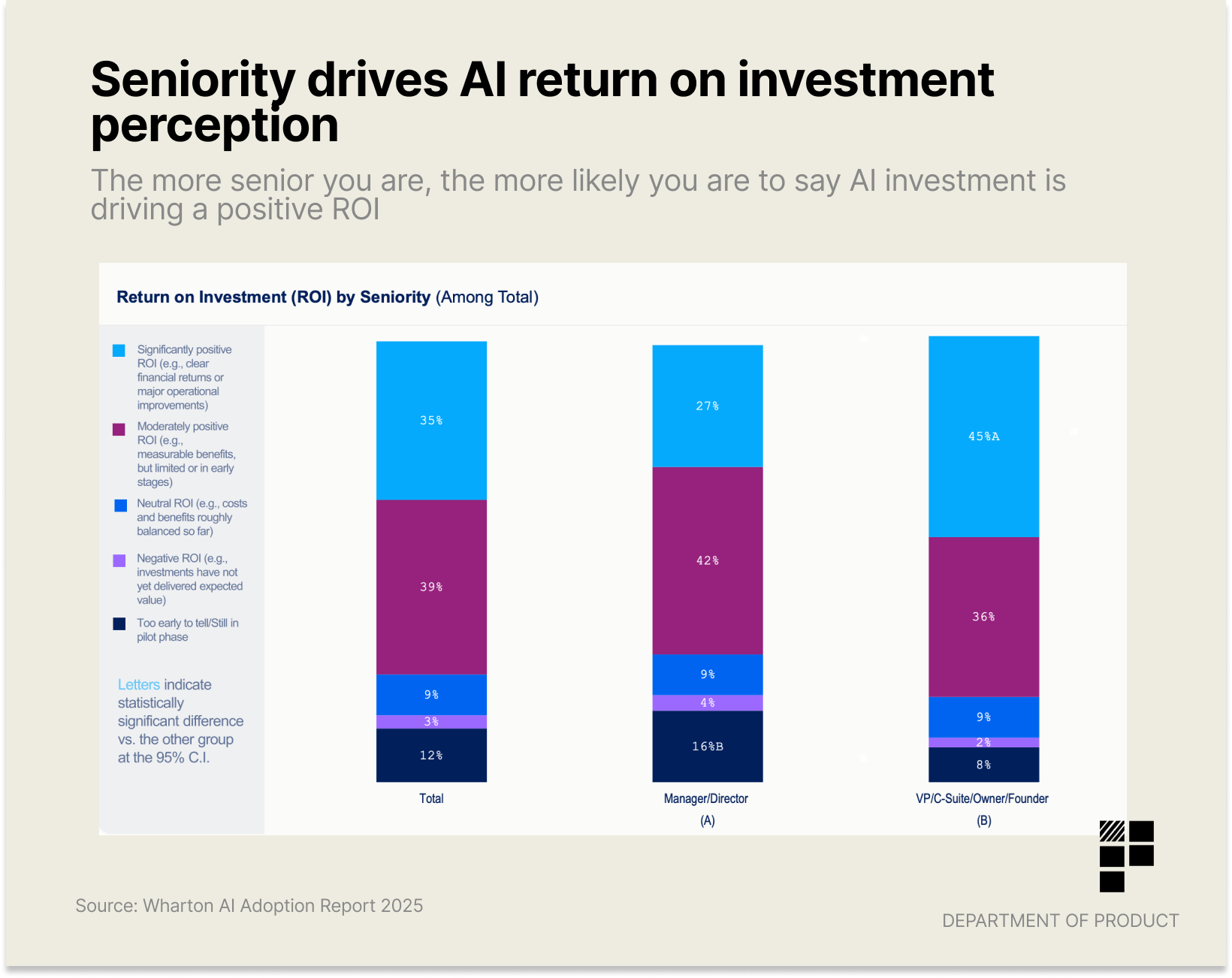
Other stats from the report that might be of interest to product teams:
ChatGPT is the leading product used by 67% of respondents, with Copilot and Gemini at 58% and 49% respectively. The least used AI tools were Deepseek, Perplexity and Claude.
88% of enterprise decision-makers report anticipated AI budget increases
60% of companies now have a Chief AI Officer (CAIO)
Anthropic has quietly overtaken OpenAI to become the AI vendor of choice for enterprise companies.
The conversion rates of organic traffic from ChatGPT is lower than all channels except paid social. A new study looked at Google Analytics data from 973 websites and 50k ChatGPT‑referred transactions versus 164M from traditional channels across Aug 2024–Jul 2025. It found Organic search still outperforms oLLM by approximately 13%.
After rumours of AI job replacement in its warehouses, Amazon this week confirmed that it would slash 14,000 jobs across its corporate workforce. A new piece in the Wall Street Journal documents the struggles of workers in their 20s, 30s and 40s to find new jobs in tech with some resorting to having to sell their homes as a result of job losses.
But, the efficacy rate of AI Agents for fully completing end to end tasks is still very low. A fascinating new paper, entitled Remote Labor Index, developed by the Center for AI Safety, evaluated the performance of AI agents on across 240 projects across tasks like video editing, music production and product design and found that current agents achieve an automation rate of up to just 2.5%. As part of their research findings, they published this handy tool which lets you choose each task and compare the output of the AI agent from each model vs the human completed version.
Paid subscribers get the full DoP Substack including: The Knowledge Series for sharpening your tech / AI skills, the AI Prompt library and DoP Deep dive reports to learn from the world’s top tech companies.