🔵 Google's Deep Research gets a powerful new feature for Product Strategy creation

Plus: Perplexity and Amazon fight the AI agent wars, the top AI books to read in 2025, YouTube’s product re-org...
Hi product people 👋,
Coming up this week, new capabilities to Google’s Deep Research make it a powerful tool for product strategy, Perplexity and Amazon go to war over AI browsing agents and new data from Microsoft shows which countries are adopting AI quickest. Plus, new prompts and mini apps in the app library for pricing and feature assessment, an AI reading list for 2025 and more.
Happy Friday!
Rich
Watch on YouTube | Follow on Substack Notes
Google digs into your Google Drive for Deeper Research; Perplexity and Amazon start the Agentic commerce wars
Google’s Deep Research can now include files from your Google Drive. When you’re performing a Deep Research, you’ll get the option to upload source materials from a Google Drive including Docs, Slides, Sheets and PDFs. This can then be mixed with real-time data from the web. Google’s VP of Gemini shared how people are already using it and for product teams, this could be particularly helpful for scenarios where you’re working on new go-to market strategies and want to reference your internal files or in scenarios where you want to synthesize user research findings and include these in wider market analysis projects.
Google says the addition of Drive into Deep Research is one of its most requested features and that a mobile version is on the way, too.
Other new releases from Google include a new conversational feature in Google Maps which it says transforms Maps into an “all knowing assistant”. Users can now ask Gemini open-ended questions from within Maps, either while driving or out walking. So for example, you can now ask Gemini for recommendations for certain restaurants along a specified route, and then request that the route be altered to include directions to one of the recommended places. Watch it in action here.
Google’s AI Mode in Search is getting a brand new set of agentic capabilities that will perform actions on behalf of users. Users will be able to perform actions like making a dinner reservation that meets a user’s preferences and booking concert tickets. AI Mode will find real-time availability for restaurants and then present you with a list of restaurants that include reservation slots. Google says it’s currently working with partners including OpenTable, Resy, Tock, Ticketmaster, Stubhub and more.
But not everyone is happy about the rise of agentic browsing and ecommerce.
This week, Amazon sent legal threats to Perplexity over its own agentic browsing capabilities. Amazon says Perplexity’s Comet AI is secretly accessing the Amazon Store, mislabeling itself as Chrome, logging into user accounts, and degrading the shopping experience and security. Citing CFAA and California’s CDAFA, Amazon claims that Perplexity’s Comet browser is breaching data laws and poses a security risk to users which is costing the company money to tackle.
On one hand, Amazon risks being left behind by attempting to ban third party AI browsers from performing agentic actions, but on the other, you can understand why Amazon might not want to remove real human users from its platform - particularly when its ads business is worth $60 billion. Perplexity’s CEO published his own response saying “Bullying is Not Innovation” - and that AI Agents are a natural extension of a user.
Other new releases this week
Windsurf has launched a new feature called Codemaps that’s designed to help engineers “understand code before you vibe it”. The new feature will create a visual representation of your product’s codebase and instantly link to the relevant part of the code base when you click on specific parts of the diagram. This is primarily designed for new developers to get up to speed quickly but could equally be helpful for product managers, designers and other non-technical folks who want to get a better understanding of their codebase.
Fresh after releasing AI slop filters, Pinterest has launched an AI Assistant that lets users describe what they’re looking for conversationally and it responds with tailored, shoppable results based on users’ tastes. In a sense, it’s a new way for users to search for items they want to find on Pinterest in the same way that Spotify DJ is for users to find music. Pinterest says that the Assistant leads to a 30% jump in the relevancy of shopping recommendations. Their CEO says that the company has been impressed by the performance of open source AI models and plans to use these to power more AI features in the future.
Key reads and resources for product teams
New from the Department of Product Substack this week:
Knowledge Series - What is parallel AI agent coding?
“A recipe for insane development speed”. Why tech leaders at Chrome, Cursor and more believe this is the next big shift in software development. In this Knowledge Series, we’ll cover the essentials of parallel AI agents, including the core technologies used, architectural patterns and how this might impact the future of product development.
New prompts and mini apps in the library
The mini app library contains a series of prompts and mini apps designed specifically for product teams. New this week:
Pricing simulator to develop new product pricing strategies - use this prompt to analyze potential pricing changes to your product and simulate how this might impact customer demand. A price elasticity demand mini app is also included to let you change your product’s prices and see how this impacts demand for your product.
Uncover hidden complexity in new feature development - use this prompt to thoroughly evaluate new product features and uncover hidden complexity that you may not have considered before you build them. It includes deep technical edge cases to discuss with engineers, unintended consequences, legal and compliance issues and assumptions to test and validate.
Process - How design teams are reacting to 10x developer productivity from AI
At this point it’s pretty obvious that AI coding agents can massively accelerate the time it takes to build software. But when software development teams experience huge productivity booms, how do design teams respond? Here’s the most common reactions Luke Wroblewski’s seen. (Luke Wroblewski blog)
Resource - The top AI books to read in 2025
Discover the non‑technical AI books that actually matter in 2025. This new, data‑driven Top 20 - curated by Michael Spencer and Paul Morrison of AI Book Review - maps four big themes: Navigating AI, Boom vs Doom, AI at Work, and Movers & Shakers. ( )
Strategy - Why traffic is no longer a reliable growth metric
AI search is upending growth. Why leaders at Webflow and across B2B GTM say high‑intent traffic now comes from ChatGPT - not Google - and converts dramatically faster. (Substack)
YouTube’s product org structure reshuffle
A leaked memo has revealed how YouTube is structuring its product teams. YouTube CEO Neal Mohan has confirmed that the company is to restructure its product teams around 3 distinct product orgs: viewer products, creator / community products and subscription products. Before this move, all product teams reported to one chief product officer but these new groups will report directly to the CEO.
YouTube’s UX teams are also merging with engineering and will report to the VP of Product and Engineering Scott Silver. Mohan says that this new structure means UX and engineering will continue to operate “horizontally across the organization”. The merging of UX and engineering shows that the lines between product disciplines are continuing to blur. (Business Insider)
Tools you can use
Console - designed to help tech companies auto-resolve repetitive IT requests to free up your engineering team to work on issues that matter. Recently raised $23 million.
Sandbar - a ring you can use as a conversational extension of your own thinking. It also lets you create notes, record voice memos and control music. Designed by ex-Meta user interface designers.
Wabi - this week, raised $20 million from Andreessen Horowitz with the vision to become the “YouTube of apps”. Users can build personal software and share it with others.
📈 Product data and trends to stay informed
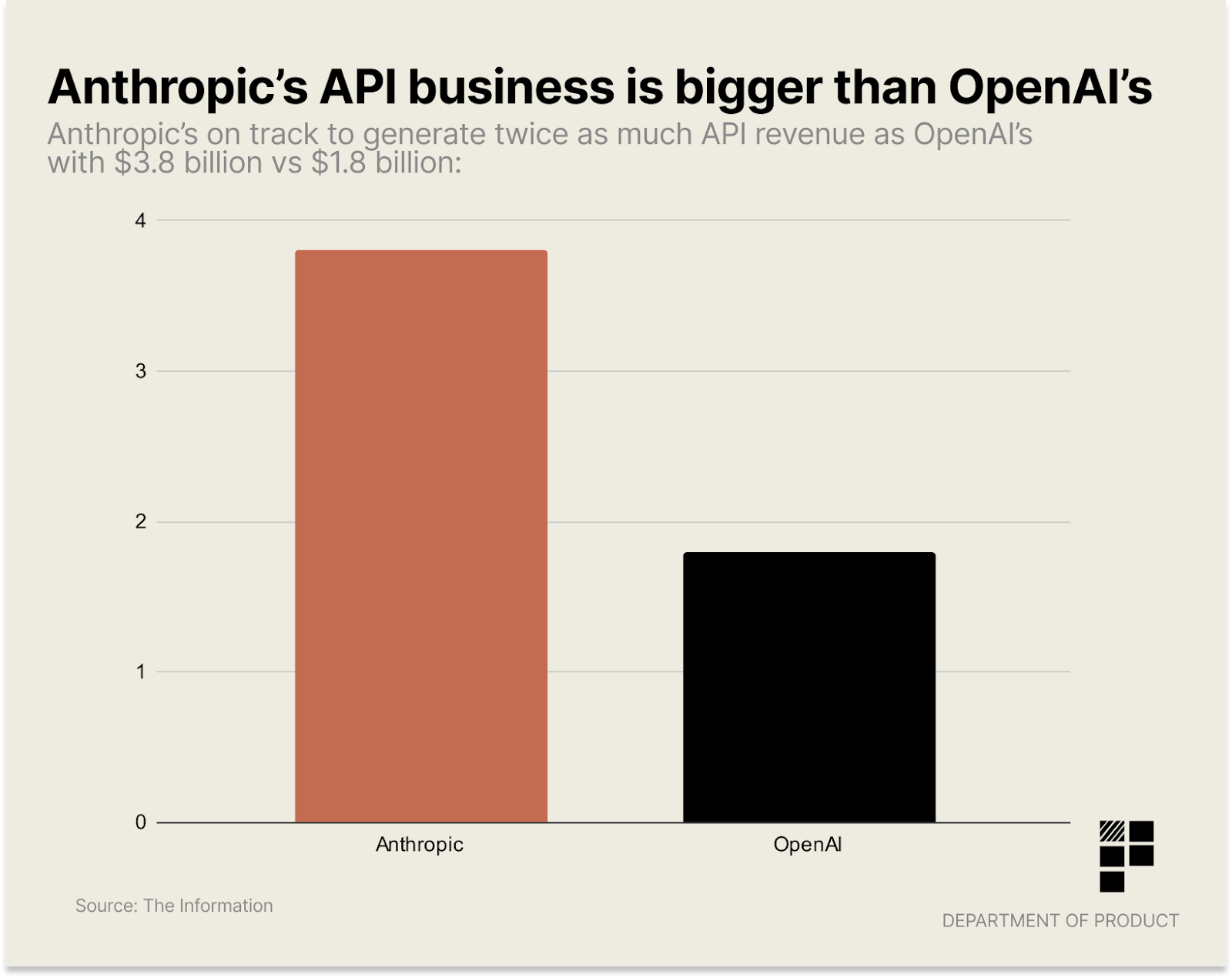
Anthropic predicts that its API business will generate twice as much revenue as OpenAI’s with revenues of $3.8 billion this year vs $1.8 billion:
OpenAI, it seems, is doubling down on its consumer products with hopes it can introduce new monetization strategies. This week, the head of Sora confirmed that the economics are “currently unsustainable” and has released the ability to buy extra gens, priced at $4 for 10 videos.
Not everyone can afford to take part in the AI revolution, though and new analysis from Microsoft puts this into context. Microsoft’s AI Diffusion report shows that The UAE, Singapore, Norway, and Ireland are the global leaders in AI adoption at 59%, 58%, 43% and 42% respectively . AI adoption correlates with higher GDP per capita. Link to full new Microsoft AI Diffusion report.
Google says the launch of Nano Banana has led to a “very big demographic shift”, with “huge growth” in the 18-34 year old group, moving from being male dominated to having more female users.
Uber’s ads business has grown 60% year on year and is now generating $1.5 billion a year.
Taxes for AI agents? A UK lawmaker has asked the government’s Chancellor of the Exchequer to consider a tax on business where an AI agent has replaced a human worker.
Shopify says AI traffic is up 7x since January of this year and purchases attributed to AI-powered search have increased by 11x. Speaking on the company’s latest earnings call, the President of Shopify Harley Finkelstein said that 64% of Shopify’s customers say that they’re likely to use AI to some extent in their buying.
