Gemini 3 and Figma's new feature automates even more of the product development process
But: Is the AI slop backlash signalling a return to human-centered features?...
Hi product people 👋,
Gemini 3 is officially here, and this week I take a look at what its arrival means for the people who build products. Plus, Figma announces a new feature for its Lovable rival that transforms the product development process. And do the latest releases from Spotify, Amazon, and TikTok mark a shift away from AI slop and back towards human‑centricity?
Happy Friday!
Rich
Watch on YouTube | Follow on Substack Notes
Key reads and resources for product teams
New from the Department of Product Substack this week:
New prompt in the library - Become more creative with your own Pixar Creativity Coach
Use this prompt to work with your own creativity coach using the exact principles and processes from Pixar. The creativity coach will systematically break down your current thinking process and help you - and your company - become more creative. The principles can apply to strategic decisions, problems you’re facing or new feature development. A summary of the book Creativity Inc is also included.
Knowledge Series - AI playground - 10 new ways to get hands on experience at work
In this latest AI playground, we’ll take a look at 10 new ways you can use AI at work. Each of these examples is designed with product teams in mind and covers everything from using Gemini Deep Research to craft a go-to-market plan from the contents of your Google Drive through to saving your CFO money by using AI agents to read through contracts and haggle prices with third party vendors. (Department of Product)
Design inspiration - Apple showcases how teams are using Liquid Glass and Apple’s new design languages
Learn directly from developers about how they implemented the new design and Liquid Glass across Apple platforms. In this series of online presentations by third-party teams like Slack, LTK, and Tide Guide, you’ll find out how developers of all sizes are embracing native design, expressing their brand identities, and quickly and successfully adopting the latest features. This activity also includes a panel discussion with Apple designers. (Apple)
Product marketing - How to use AI agents for product marketing
Insights into how one company’s GTM engineering team built four agentic workflows - AI lead enrichment, an Auto BDR, lifecycle personalization, and a custom AI app layer - that turned organic demand into measurable results. (Substack)
Leadership - How to lead a team when your strategy keeps changing
A Harvard Business Review discussion on what to do when you’re leading a team at a company where your strategy keeps changing. With or without help from above. (Harvard Business Review)
Automation - OpenAI’s co-founder on how to identify suitable tasks for automation
The more a task/job is verifiable, the more amenable it is to automation in the new programming paradigm. If it is not verifiable, it has to fall out from neural net magic of generalization fingers crossed, or via weaker means like imitation. (Andrej Karpathy)
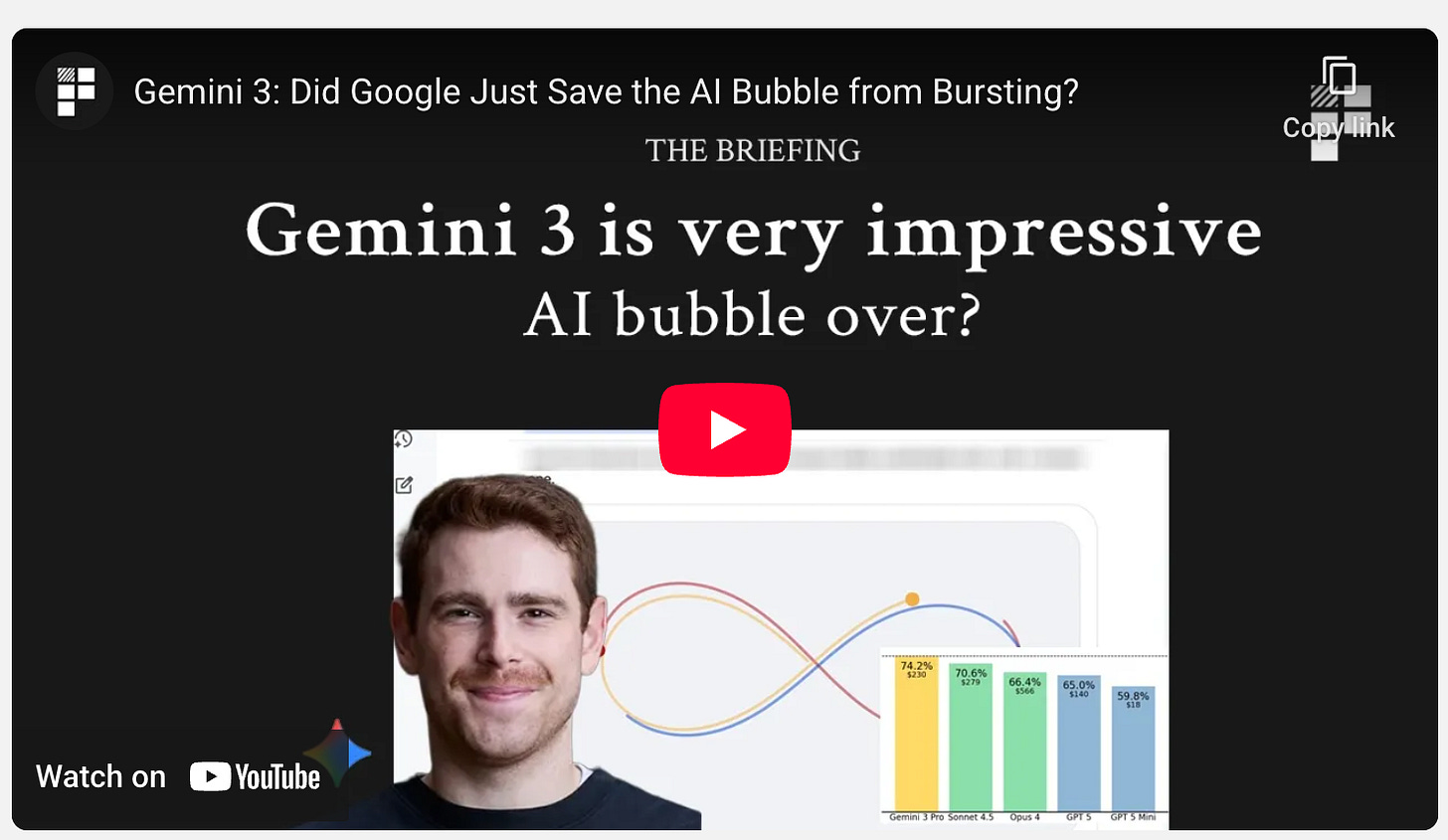
Did Gemini 3 stop the impending AI bubble burst?
Gemini 3.0 is officially here - and the early reactions to the model so far have been incredibly positive. After the relative disappointment of GPT-5, commentators and the markets were warning of an impending AI bubble burst, but the arrival of Gemini 3.0 seems to have quelled those fears, at least for now.
Here’s a snapshot of its performance across various different benchmarks - including humanity’s last exam which tests for academic reasoning and the terminal bench score for agentic terminal coding. It fails to beat Claude’s Sonnet 4.5 in the SWE-Bench Verified test - but tops every single other benchmark. For developers, Gemini 3.0 puts Google back into the mix as a legitimate coding partner and Google marked the launch with the release of a new agentic coding tool called Antigravity which pits itself directly against tools like Cursor and Visual Studio Code. Early reactions to that have been equally impressive.
Aside from coding, if you’re looking to teach yourself about new concepts, Gemini 3.0’s integration directly into AI Search Mode is particularly powerful. The new integration will take any concept that’s returned in the search result and transform it into interactive components. In this example, a complex topic like RNA is transformed into interactive components to help the reader understand it and Stripe’s CEO Patrick Collison took this principle and used Gemini 3.0 to ask it to build a visual representation of the most important scientific discoveries in the past 15 years.
It is these visual capabilities, according to its product lead, Madhu Guru, where Gemini 3.0 really excels. Speaking on X, he says that the model is super good at front end development and vibe coding and the examples he shared seem to back this up; Gemini 3.0 successfully one-shotted various web artifacts including a landing page for a watch, an old school terminal and a bento-box style portfolio.
Google also released Nano Banana Pro this week - the updated version of its image editing tool. Shopify’s CEO showed how he used it to transform a talk into an infographic.
Figma seizes the Gemini 3 moment with new Make features
Since the new Gemini is so impressive at visual design, Figma’s CEO jumped at the opportunity to integrate the model into its own product set. This week, after declaring that the model is “very impressive”, Figma quickly rolled out a bunch of new features that help product teams get the most out of its abilities during the product design process.
The most significant of these is the new integration into Figma Make - Figma’s competitor to Lovable. Users can now select Gemini 3.0 as their preferred model when creating designs in Figma Make and this week, the company also rolled out a major new feature with the release of its new MCP functionality called Connectors. With Connectors, Figma Make now has access to a bunch of different third party tools including tools like Notion and Linear.
In this example, you can use the context of Linear issues to generate prototypes. In other words, Figma Make will read the contents of Linear tickets and then auto-apply these design changes to prototypes. The feedback for this feature so far from people who have used it is very positive - but with AI now able to create issues, design them and build them - every member of a modern product team is now exposed to AI automation to some degree, not just engineers. The release of Gemini 3 may accelerate this trend further.
AI slop controls - and a return to human-centricity in UX?
But while some companies are doubling down on their efforts to integrate AI, others are handing control back to users.
Following in the footsteps of Pinterest and Spotify, TikTok is the latest company to offer users controls over how much AI generated content they see. But, rather than a binary toggle offered by Pinterest, on TikTok users can set their AI preferences using a sliding scale across each topic. The scale is set in the middle by default with users able to drag it to the left if they want less AI generated content or to the right if they want more. It’s also rolling out new invisible watermarking technology to make it impossible to re-purpose AI generated content without correctly labelling it as such.
New data from OpenAI’s Sora app seems to back up the idea that users are fatigued with AI generated slop. This graph shows Sora is struggling to retain users with 30 day retention rates of less than 1% - far less than TikTok’s 30%.
As a result, product teams appear to be leaning into human-centricity with the launch of new social features.
Amazon Music is adding a new “Fans” feature which allows users to self-identify as a fan of a particular artist and allow others to follow them in a Fan group. Spotify is adding a new feature called SongDNA which showcases the real world humans behind a song. And this week, YouTube started an experiment with a new social feature where users can send messages directly inside the YouTube mobile app.
So it seems that as product teams continue to remove humans from many processes by offloading them to AI, they’re also adding new features which seek to add authentic human connections. Perhaps this is the start of a wider trend back towards human-oriented UX or maybe this is just a coincidence.
Tools you can use
Poly - an intelligent file browsing system. Search inside your videos, documents, photos alongside an agent that can research, answer questions, and organize your files for you.
Snippets - the all-in-one prompt manager that wants to replace Notion, GitHub, and Google Docs for storing your team’s AI prompts. Save all your best prompts in one place, organize them effortlessly, and share them with your team instantly.
Everyday - get your every day tasks done across apps. Clears your inbox, organizes your day, and keeps work moving while you focus on what matters.
📈 Product data and trends to stay informed
Reddit, LinkedIn and Wikipedia are the top 3 most cited domains in LLM powered search results according to new analysis. Despite topping the list, Reddit suffered an abrupt decline in traffic referrals from ChatGPT, dropping from over 60% share of responses down to less than 20% in just a few months.
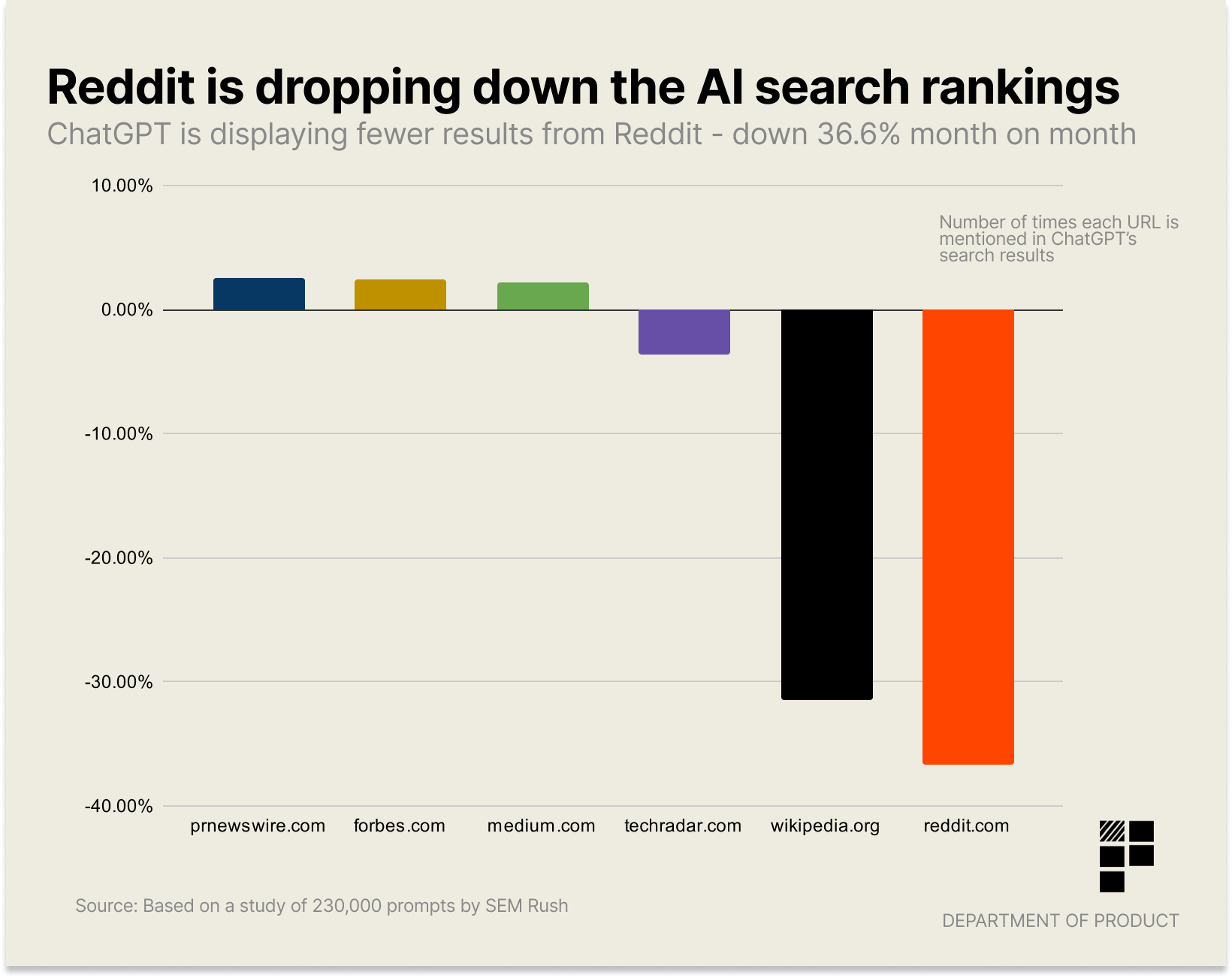
LinkedIn is enjoying a steady rise across all platforms with Google’s AI Mode most pronounced and Forbes is also on the rise: Forbes doubled its number of AI responses with a citation after September.
This week Benedict Evans released his biannual presentation exploring macro trends which is always a good read. In it, he makes the argument that for every new platform, we forget how many ideas failed and how unclear everything was. In the context of AI, he points to browsers, AI agents, voice, MCP and GEO as examples of new trends that may or may not be a glimpse of what the future looks like.
Key insights from the presentation that might be relevant for product teams:
Data center capacity is on track to triple over the next 5 years and compared to 2022, there are now far more AI models. The models are starting to converge and the leaders change weekly.
ChatGPT has emerged as the leading consumer product of the AI age with a weekly active user share close to 20% across multiple different geographies including the USA, UK, France, Denmark and Japan
Most users are weekly active users - not daily active users, suggesting that the stickiness of AI products is lower than previous generations of consumer products.
Automation appears to be one of the core use cases for AI and while some may smirk at this as a strong value proposition, he argues that the launch of barcodes led to the growth in SKUs in supermarkets - and profound shift in how we buy things.
TikTok Shop is now roughly the size of eBay.
Open source coding editor Sourcegraph is generating between $5 and $10 million in revenue by selling ads directly inside the code editor’s prompt interface. The company’s CEO says developers are pretty happy with the trade off and think the ads are “tasteful”.
AI budgets have doubled in the past year with 30% of AI budgets now allocated to AI Agents. New report from SalesForce.
Paid subscribers get the full DoP Substack including: The Knowledge Series for sharpening your tech / AI skills, the AI Prompt library and DoP Deep dive reports for in-depth analysis to learn lessons from the world’s top tech companies.