How to Identify Opportunities for AI Automation - a Framework for Product Teams
If automation is AI’s superpower, when and where should you use it? Figuring out what to automate and why. Knowledge Series #93...
🔒 Grow your technical and AI knowledge with the The Knowledge Series. Get full ongoing access to over 90 technical explainers and AI guides. Multiple new guides are added every month.
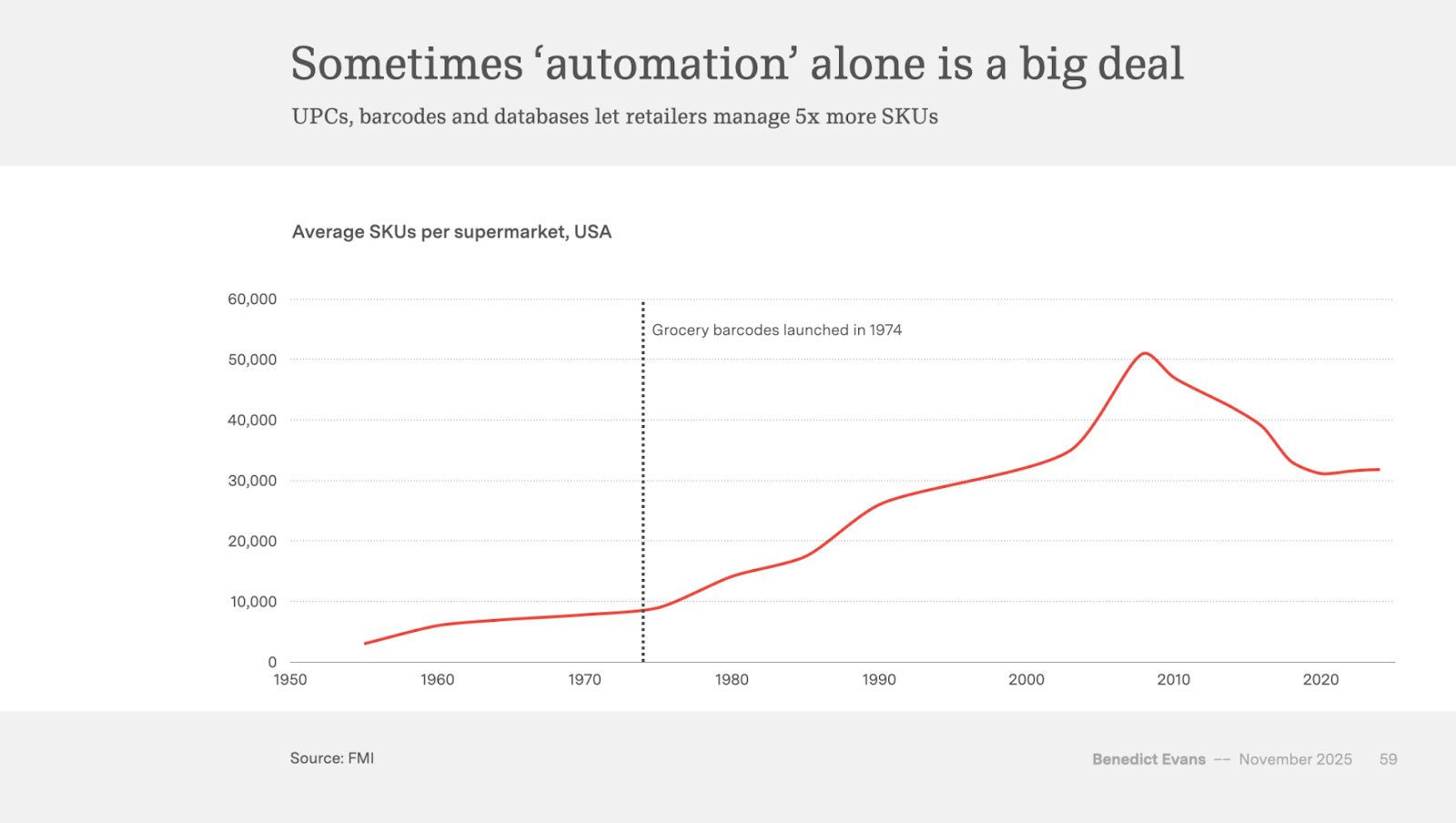
In tech investor Benedict Evans’ latest presentation on AI, he makes the argument that right now, automation is AI’s biggest superpower.
He suggests that while it’s easy to sneer at, sometimes automation alone is a big deal. Here’s this argument in context, where he shows the impact of automation on the retail industry through barcodes and databases:
In a product context, every week, companies are shipping new releases which chip away at more and more parts of the product development process through automation. New coding models from Anthropic and Cursor make it easier to generate code, Figma Make’s new MCP servers combined with Gemini 3 has transformed MVP design into a 1-shot task and new features like Linear’s Slack context awareness turn bug reporting and requirements gathering into a fully automated process.
Just because you can automate something doesn’t mean you should; the output from these automation efforts is far from perfect in many cases. But the topic of automation is now firmly top of the agenda in many companies. And in companies who want to demonstrate meaningful real world results from so-called AI transformation, it is product teams who are increasingly being tasked with identifying these opportunities for AI automation.
And that’s what this post is designed to help you with.
In this Knowledge Series, we’ll explore some of the ways you can identify opportunities for AI automation. You’ll get a concrete step by step framework for identifying AI automation opportunities, prompts to use for automation opportunity analysis along with real world examples of how other companies are automating product-related processes to use as inspiration.
Coming up:
AI automation opportunities - what OpenAI’s co-founder says
Real examples of AI automation in practice for product teams in important areas including design, product requirements and operations.
A practical framework you can use to identify AI automation opportunities in your own company. The framework lets you assess opportunities across 3 dimensions and plot them visually to encourage discussion.
Bonus downloads and resources
Downloadable template you can use for AI automation opportunity analysis
Practical AI prompts you can use to identify automation opportunities and measure their impact post-release
An interactive mini app to use in a workshop for assessing and choosing AI automation opportunities to explore further
What OpenAI’s co-founder says about identifying good AI automation candidates
OpenAI’s co-founder recently shared his thoughts on what makes a good candidate for AI automation:
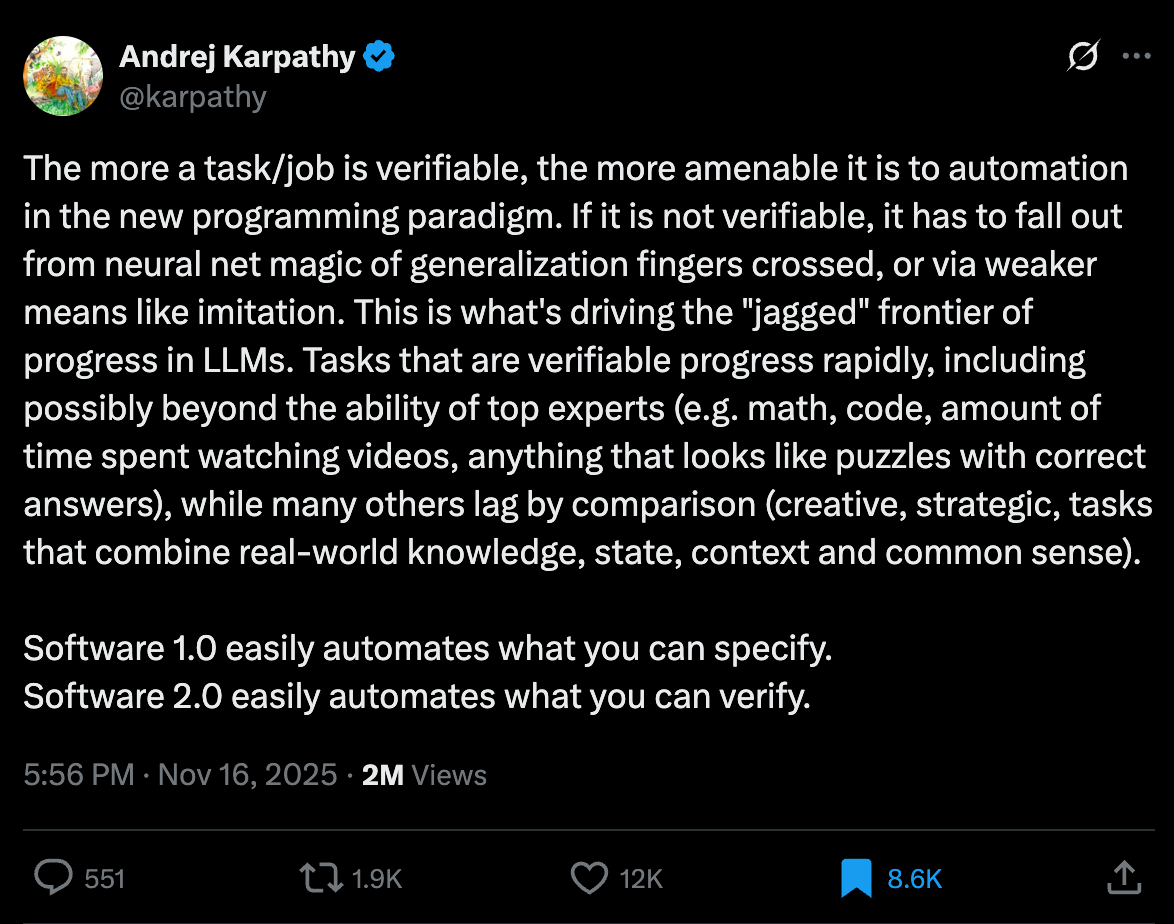
In his view, a good candidate for AI automation is a task that is easily verifiable. The more a task or job is verifiable, the more amenable it is to automation. In other words, if you can prove that something is automated accurately, it’s worth exploring as a potential candidate for automation. His quote is mostly in reference to programming but this principle can be applied to automation use cases beyond programming; if any process is easily verifiable, it might be a strong candidate for AI automation.
We’ll use this principle to shape our thinking when we look at a practical framework you can use for identifying your own opportunities for AI automation.
What do we mean by AI powered automation?
For better or worse, AI is now capable of automating many of the tasks involved in product development. That isn’t to say it’s always desirable to automate these tasks of course, just that in many cases, it’s possible.
The steps involved in an AI powered automation
An AI powered automation typically involves a mix of some or all of the following steps:
Something triggers the workflow (an event in a product, a user action, a system signal).
Relevant data is collected and prepared so the AI can actually work with it.
An AI model interprets that data (classifies, predicts, generates, summarizes, etc.).
Logic around the model output decides which path to take (e.g. auto-approve vs send to human).
Actions are executed in downstream tools (update DB, send email, create ticket, change feature state), and the result becomes new data for next time.
These workflows can be deterministic or non-deterministic in the case of AI agents. More on agentic workflows here.
Practical examples of automation in the product development process
Here’s a snapshot of some recent examples of AI automation used in the product development process:
Figma Make Connectors can automate prototyping
Released last week, Figma Make’s new Connectors feature can automate the process of creating prototypes by connecting Figma directly to third party tools like Notion and Linear. Once a Connector is set up, it will read the requirements in a PRD and create the prototype automatically based on the contents of the PRD. Earlier this week, Figma published a demo video1 outlining how to use this which is worth a look and Linear’s COO describes this as “context-driven prototyping”.
Claude can automate SEO quality checks
When tools like Claude Code is paired with MCP servers like Playwright, it can now take control of your browser and automate the process of conducting SEO audits. It will scan a page, identify the elements on it and produce a report within a few minutes.
Walmart’s AI agents can automate market research
Just recently, Walmart confirmed it is using AI agents to source products by reading real-time trend signals - like what teenagers are buying - and translating those insights into specifications and patterns for new fashion items. One agent, the Trend to Product agent, shortens the traditional six‑month design‑to‑store cycle by up to 18 weeks. Executives frame this as a productivity force multiplier, not a replacement for human decision‑making. But it’s an example of AI automation used to augment traditional work to boost productivity.
How to identify AI automation opportunities in your own company
Now let’s dig into the finer details on how to identify AI automation opportunities for your own product. We’re going to consider two different perspectives:
internal opportunities for transforming internal processes and
external opportunities where you build automation features that your own users will use
For each of these, we can use a framework that’s been specifically designed for this process that draws inspiration from OpenAI’s co-founder and the wider state of AI automation technology today.
The AI Automation Opportunity framework explained
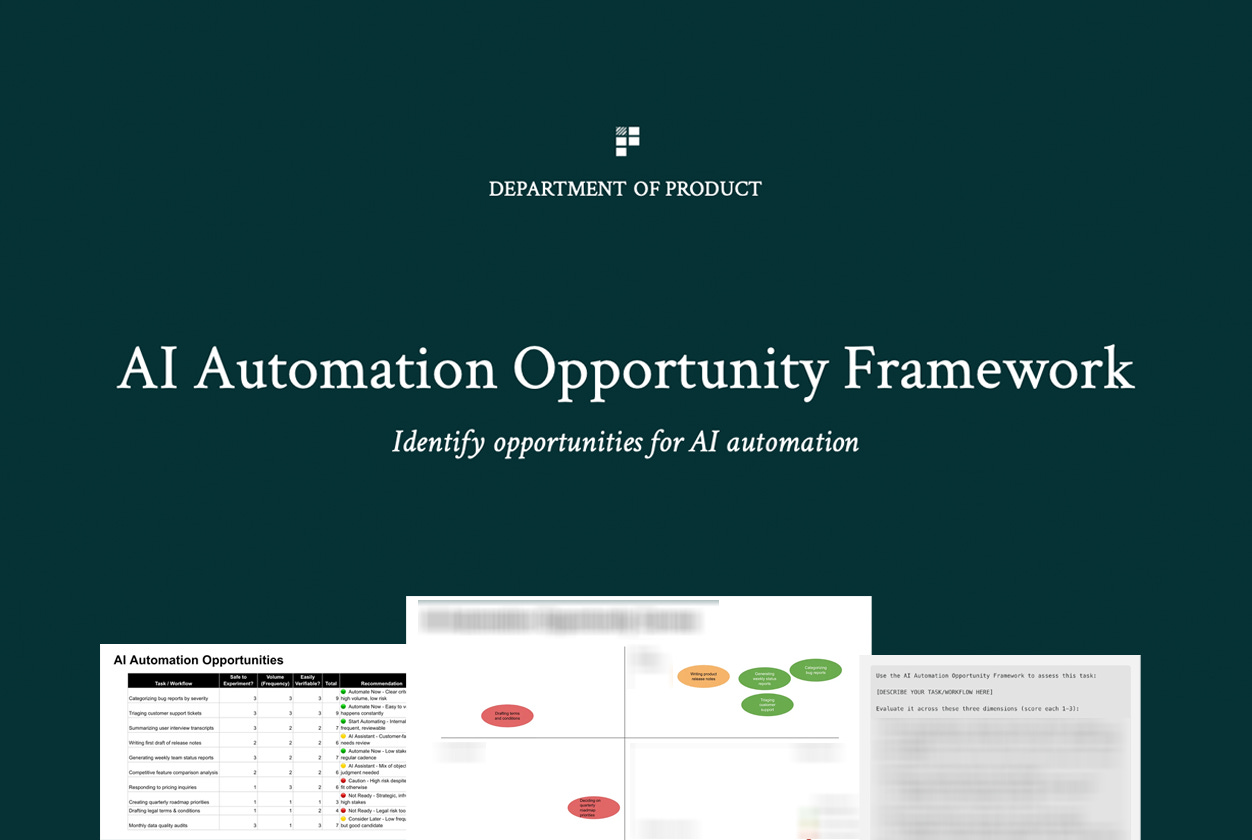
The framework helps us assess AI automation opportunities across 3 distinct dimensions: